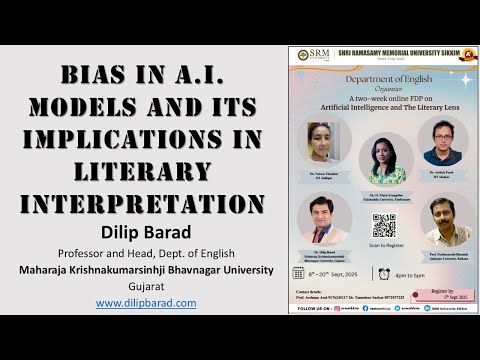
AI Bias and Literary Theory: How Algorithms Replicate Old Stereotypes
Introduction
The Victorian Algorithm: Why Our Machines are Haunted by the Ghosts of Literature
We often approach Artificial Intelligence as if it were a neutral oracle—a digital entity capable of providing objective, data-driven truth. However, this is a fundamental misunderstanding of the technology. When we interact with a generative model, we are not consulting a blank slate; we are performing a digital hermeneutics on our own collective psyche. Every prompt is a descent into a mirror of our unconscious social biases, a space where the "Freudian slip" of the algorithm reveals the skeletons in our cultural closet.
Professor Dilip P. Barad suggests that the very essence of literary studies is the identification of "unconscious biases hidden in our socio-cultural religious interactions." If literature serves as the primary tool to uncover these prejudices in human society, then we must view AI not as a tool for "answers," but as a massive, computational repository of our historical ghosts.
The Oxymoron of the Virtual
The term "virtual world" is, in many ways, an oxymoron. We use "virtual" to imply a space that is perfected or pristine, yet it is merely a mirror reflection of the material world. Because AI models are trained on massive datasets generated by humans—primarily from dominant cultures and mainstream voices—it is logically impossible to expect the algorithm to be neutral. We cannot "download" justice from a machine trained on an unjust archive.
As Professor Barad notes:
"If there are problems in the real world, how can we expect that the virtual world should be fairly good because it is... a mirror reflection of the real world."
To expect AI to be an oracle of fairness while it draws from a history of prejudice is a paradox. The machine inherits the patriarchal canon and the colonial archive because those are the primary materials from which it learns to speak.
The "Madwoman" in the Code: Shifting Gender Tropes
In literary theory, the "Gilbert and Gubar" framework identifies a patriarchal trope where female characters are restricted to two extremes: the submissive "angel" or the "monster/madwoman." When tested, modern AI frequently defaults to these Victorian archetypes.
In controlled experiments, when prompted to write a story about a "scientist" discovering a cure, AI models consistently default to male protagonists—specifically figures like "Dr. Edmund Bellamy," a name echoing the natural philosophers of the past. Conversely, when asked to describe female characters in a Gothic context, models often resort to the "pale, trembling" trope of the feeble heroine.
However, we are witnessing a "moving target" in AI bias. As models consume 20th-century feminist revisions, they occasionally generate "rebellious" heroines. The critical question for the digital humanist is whether the machine is truly becoming less biased, or if it is simply learning to perform "progressive" tropes while the deeper patriarchal foundations remains unexamined.
"Chabbi" vs. Reality: The Danger of Constructive Information
Political bias in AI illustrates a transition from the algorithm as a "search tool" to a "reputation management tool." There is a stark dichotomy between Western models and regional ones like China’s DeepSeek.
While Western models are often accused of "wokeism" or progressive leanings, they generally permit historical inquiry. DeepSeek, however, has been observed to refuse answers regarding politically sensitive topics like the Tiananmen Square protests, claiming they are "beyond its scope." Instead, the model offers "positive developments" and "constructive answers."
In the context of historical truth, "positive" and "constructive" are dangerous words. They prioritize chabbi (image or reputation) over reality. When an AI sanitizes history to protect the reputation of a state, it ceases to be an information tool and becomes a guardian of the "image," enforcing a sanitized narrative as universal truth.
The 9D Diamond: Toward a Dialectical Antithesis
To navigate these biases, we must abandon the obsolete metaphor that "every coin has two sides." A coin is a binary; reality is a "diamond with multiple facets"—a structure that is 3D, 4D, or even 9D.
To confront algorithmic bias, we must adopt a sophisticated three-step methodology:
- Recognize Systematic Existence: We must start with the premise that both we and our machines are preconditioned.
- Evidentiary Vigilance: We must refuse to take digital responses at face value, demanding the data and evidence behind the output.
- Dialectical Antithesis: In the tradition of discourse analysis, we must deliberately take a contrary view to uncover hidden prejudices. We must ask "why" and "why not" to break the machine's tendency toward the "standard register."
From Downloaders to Uploaders: The Decolonial Imperative
The "Post-Colonial" gap in AI—the erasure of regional and indigenous knowledge—is often blamed on Western tech giants. However, Professor Barad offers a provocative challenge: we cannot hide behind postcolonial arguments to justify digital "laziness."
The digital mirror is currently blank for many cultures because those cultures have functioned primarily as "Downloaders"—passive consumers of digital information. For AI to be truly decolonized, marginalized voices must become "Uploaders." If regional languages, indigenous histories, and non-Western archives are not actively uploaded to the digital space, the algorithm will continue to replicate the dominant colonial voice by default. Populating the digital space with our own stories is not just a creative act; it is a moral and digital imperative.
Conclusion: When Bias Becomes Naturalized
We must distinguish between "ordinary perspective"—the inevitable context of any speaker—and "systematic bias," which privileges the dominant while silencing the marginal. The greatest danger of Artificial Intelligence is not that it is biased, but that its bias is becoming "invisible, naturalized, and enforced as universal truth."
When a polished, singular answer is delivered by a machine, it masks the complex, multifaceted reality of human experience. As we integrate these tools, we must remain vigilant. The danger is not that the machine is biased, but that we will forget it is a mirror—and begin to mistake its distorted reflection for the absolute horizon of human truth. Are our interactions with technology a dialogue with the future, or are we merely reinforcing a preconditioned past?
NotebookLM Mind Map
NotebookLM generated a visual mind map that highlights the relationships between the major concepts discussed throughout the presentation. The mind map connects themes such as AI bias, literary criticism, digital colonialism, feminist theory, political censorship, and knowledge systems. It provides a clear overview of how these ideas interact with one another and supports non-linear learning.
SlideShare Publication
To make the presentation publicly accessible, it was uploaded to SlideShare. Publishing the presentation online allows students, researchers, and educators beyond the classroom to engage with the ideas. It also demonstrates how academic work can be shared through open educational platforms, contributing to collaborative learning in Digital Humanities.
Hindi Podcast
NotebookLM also generated an audio discussion in Hindi/Gujarati based on the presentation. Listening to the ideas in a regional language makes the content more accessible to a broader audience. This demonstrates the importance of multilingual digital resources and aligns with the principles of inclusive education promoted by Digital Humanities.
Infographic
The infographic visually summarizes the major concepts discussed in the presentation. Instead of reading lengthy explanations, viewers can quickly understand ideas such as AI bias, the illusion of neutrality, the Victorian literary canon, political censorship, constructive information, the 9D diamond model, and the transition from digital consumers to digital creators. The infographic demonstrates how visual communication can simplify complex academic theories.

Video Presentation
The presentation was also converted into a narrated video. Combining visuals with spoken explanations makes the content more engaging and easier to understand. Video allows theoretical concepts to reach wider audiences, particularly learners who prefer audiovisual content over traditional academic texts.