Sunday, December 14, 2025

War Poetry: A Literary Response to War

War Poetry: A Literary Response to War           

I am writing this blog as a task assigned by Prakruti Ma’am. The purpose of this task is to understand War Poetry as a literary genre and to explore how poets present the realities and impact of war. Through this blog, I aim to improve my literary understanding and critical thinking skills.

Introduction

War has always been a powerful subject in literature, but it was during the First World War that poetry began to reflect the harsh realities of conflict rather than its heroic image. War poetry gives voice to soldiers’ experiences, exposing the physical suffering, emotional trauma, and disillusionment caused by war. In the classroom, our discussion focused on how war poets use both content and form to challenge patriotic myths and reveal uncomfortable truths. This blog explores the nature and significance of war poetry, closely examines Wilfred Owen’s “Dulce et Decorum Est”, and reflects on an AI-generated war poem in comparison with the poems studied in this unit.

What is War Poetry?


Its Significance in Terms of Content and Form (Classroom Context)

War Poetry is a significant literary genre that represents the lived experiences, emotions, and realities of war. Although war has been a recurring subject in literature since ancient times, the poetry produced during the First World War marked a fundamental shift in the way war was perceived and represented. In our classroom, we began this unit by discussing the historical background of the First World War, which provided a crucial foundation for understanding the themes and techniques of war poetry. This historical context helped us recognize why modern war poetry moved away from glorification and patriotism towards realism, disillusionment, and moral questioning.

Classroom Discussion: Background of the First World War

In our classroom discussion, we examined the causes and background of the First World War (1914–1918) in detail in order to understand the historical forces that shaped war poetry. We discussed how Europe, before the war, was already a tense and unstable region due to several interconnected factors. Militarism led nations to build massive armies and glorify military power. The complex system of alliances divided Europe into opposing camps, making a local conflict capable of turning into a global war. Imperial rivalry intensified competition among European powers for colonies and resources, while aggressive nationalism encouraged blind loyalty to the nation and hostility toward others. The immediate trigger—the assassination of Archduke Franz Ferdinand of Austria-Hungary—sparked a chain reaction that quickly drew major world powers into the conflict.

Beyond political causes, our classroom discussion emphasized how the nature of warfare itself changed drastically during the First World War. Unlike earlier wars, this conflict introduced industrialized and mechanized warfare. The widespread use of trench warfare forced soldiers to live for months in narrow, muddy trenches under constant threat. New and terrifying weapons such as poison gas, machine guns, tanks, and heavy artillery caused destruction on an unprecedented scale. Battles often resulted in huge numbers of casualties without significant territorial gain, creating a sense of futility and despair.

We also discussed the psychological impact of war on soldiers. Constant exposure to death, explosions, and fear led to what was then called shell shock. Soldiers suffered from anxiety, nightmares, and emotional breakdowns. Disease, hunger, and extreme weather conditions further worsened their suffering. This brutal reality stood in sharp contrast to the romantic and heroic image of war promoted by patriotic speeches, newspapers, and earlier war literature.

Understanding this background was essential in our classroom because it helped us see why war poetry emerged as a reaction against false ideals of honour, bravery, and national glory. Poets who experienced the war firsthand felt compelled to record the truth of what they saw and endured. Their poetry challenges propaganda, exposes suffering, and replaces idealism with realism. Thus, the classroom discussion of the First World War’s background provided a crucial foundation for appreciating the themes, tone, and purpose of modern war poetry.

Impact of the First World War on British Literature

As discussed in class, the First World War had a deep and lasting impact on British literature. Many writers and poets actively served as soldiers, doctors, or officers. Their direct involvement in the war gave rise to literature that was deeply personal and emotionally intense.

War poetry became a medium through which poets could:

  • Record the truth of battlefield experiences

  • Express anger, grief, and disillusionment

  • Challenge government propaganda and public misconceptions

  • Preserve the emotional reality of war for future generations

Thus, war poetry became not just a literary movement but also a historical and moral document.

Significance of War Poetry: Content

The content of war poetry reflects the lived experience of soldiers and the moral crisis created by modern warfare. In our classroom discussions, we identified several major themes:

  • Physical suffering and death: Soldiers are shown as wounded, exhausted, and dying rather than heroic figures.

  • Psychological trauma: Fear, shock, nightmares, and emotional breakdown are central concerns.

  • Disillusionment with patriotism: Poets question the idea that dying for one’s country is noble.

  • Pity and compassion: Focus shifts to the ordinary soldier rather than military success.

The poems included in our syllabus clearly demonstrate this thematic development:

  • Rupert Brooke’s “The Soldier” reflects the early patriotic enthusiasm of the war, presenting death as honourable and spiritually meaningful.

  • Wilfrid Wilson Gibson’s “The Fear” focuses on the inner emotional terror of a soldier, showing vulnerability instead of courage.

  • Siegfried Sassoon’s “The Hero” exposes the hypocrisy of society, where comforting lies replace uncomfortable truths.

  • Wilfred Owen’s “Dulce et Decorum Est” presents a graphic portrayal of a gas attack, condemning the idea of glorious sacrifice.

  • Ivor Gurney’s “The Target” highlights the randomness and futility of death, suggesting the senseless destruction caused by war.

Together, these poems trace the transformation of war poetry from idealism to realism and protest.

Significance of War Poetry: Form

Alongside content, the form of war poetry plays a crucial role in communicating meaning. Our classroom discussions emphasized that poets deliberately shaped form to reflect the harsh realities of war.

Important formal features include:

  • Simple, direct, and conversational language that reflects the speech of soldiers

  • Striking and sometimes shocking imagery

  • Use of irony to expose the gap between public perception and reality

  • Traditional poetic structures used to subvert traditional war ideals

For example, Wilfred Owen’s use of a regular stanza form in “Dulce et Decorum Est” contrasts sharply with the chaotic and horrifying events described in the poem. This tension intensifies the reader’s shock and reinforces the poem’s anti-war message. Similarly, Sassoon’s controlled tone in “The Hero” enhances the bitter irony of the poem.

War Poetry as a Moral and Literary Response

As emphasized in our classroom discussion, war poetry functions as both a literary response and a moral protest. These poets act as witnesses who record truths that society often chooses to ignore. War poetry challenges authority, questions nationalism, and gives voice to the suffering of ordinary soldiers.

By engaging with both the historical background and the literary techniques, we were able to understand war poetry as a form of resistance against false narratives and as a powerful expression of human suffering.

The Tension Between Message and Form in “Dulce et Decorum Est” by Wilfred Owen

Wilfred Owen’s “Dulce et Decorum Est” is one of the most powerful anti-war poems of the First World War. What makes the poem especially effective is the tension between its message and its form. Owen does not rely only on what he says about war; he also carefully shapes how he says it. By placing a brutal anti-war message within a controlled and traditional poetic form, Owen exposes the false ideals of patriotism and heroism that surrounded the war.


 The Anti-War Message of the Poem

The central message of “Dulce et Decorum Est” is a strong condemnation of war. Owen presents war as physically brutal and morally destructive. The poem opens with exhausted soldiers, “bent double, like old beggars under sacks,” immediately breaking the romantic image of young, heroic warriors.

The gas attack scene forms the emotional core of the poem. Owen describes a soldier who fails to put on his gas mask in time and dies a horrifying death, “guttering, choking, drowning.” Through this graphic imagery, Owen forces the reader to witness the true cost of modern warfare.

The poem ends with a direct attack on the Latin phrase “Dulce et decorum est pro patria mori” (It is sweet and fitting to die for one’s country), which Owen calls “the old Lie.” Thus, the message of the poem is clear: war is not glorious, and patriotic slogans are cruel deceptions.

 The Traditional and Controlled Poetic Form

In contrast to its violent content, the form of the poem is carefully controlled. Owen uses:

  • Regular stanza divisions

  • A structured rhyme scheme

  • Traditional poetic devices such as simile, metaphor, and rhythm

The poem follows a clear narrative progression—from marching soldiers, to the gas attack, to the poet’s reflection and condemnation. This sense of order in structure contrasts sharply with the chaos and horror of the battlefield.

Owen’s use of poetic form shows his technical mastery, but it also connects his poem to the traditional war poetry that once glorified battle and sacrifice.

 Tension Between Chaos and Control

The most striking tension in the poem lies between the chaotic reality of war and the controlled artistic form used to describe it. While the soldiers experience confusion, panic, and death, the poem itself remains formally disciplined.

This contrast serves an important purpose:

  • The orderly form highlights the disorder of war

  • The controlled rhythm makes the violent images more shocking

  • The calm structure contrasts with emotional trauma

By maintaining formal control, Owen avoids emotional exaggeration and instead presents horror with stark clarity, making it more convincing and disturbing.

 Irony and Subversion of Traditional War Poetry

Owen deliberately uses traditional poetic form ironically. In earlier war poetry, such forms were often used to celebrate honour, courage, and patriotic sacrifice. Owen turns this tradition upside down.

By placing horrifying images inside a poetic structure associated with beauty and nobility, Owen exposes how language and form have been misused to romanticize war. The poem becomes a critique not only of war itself but also of the literary and cultural traditions that supported it.

 Effect on the Reader

The tension between message and form deeply affects the reader. The formal structure draws the reader in, but the content shocks and disturbs. This emotional conflict forces readers to question:

  • The truth of patriotic slogans

  • The morality of war

  • The responsibility of poets and writers

The reader is left unsettled, which is exactly Owen’s intention.

In “Dulce et Decorum Est”, Wilfred Owen creates a powerful tension between what the poem says and how it is said. The poem’s traditional form contrasts sharply with its anti-war message, exposing the lie of noble sacrifice. This tension strengthens Owen’s protest against war and transforms the poem into a lasting statement of truth, compassion, and moral resistance.

AI-Generated War Poem and Critical Reflection

Prompt Given to the Poetry Generator

Write a war poem on the Indo-Pak War of 1971 in the style and tone of Wilfred Owen.

Generated Poem

“December, 1971”

Bent beneath winter rifles and orders,
They moved through fields once green with harvest songs.
Mud clung to boots like memories of home,
While distant shells erased the quiet sky.

A boy from Gujarat gasped beneath the smoke,
His breath caught fast like Owen’s choking men,
Eyes wide with dreams unfinished, unreturned,
As comrades shouted orders drowned in fire.

No songs of glory followed where he fell,
Only the echo of a mother’s prayer.
Do not speak to us of honour or of pride—
We learned too late the cost of words like these.

Reflection on the Generated Poem

Comparison with War Poems Studied in the Unit

The AI-generated poem attempts to imitate the style and tone of Wilfred Owen, especially his emphasis on physical suffering, pity, and anti-war sentiment. Like Owen’s “Dulce et Decorum Est”, the poem avoids glorifying war and instead focuses on the ordinary soldier’s experience. The image of a soldier gasping for breath recalls Owen’s famous gas-attack scene and reinforces the idea that war destroys young lives before they are fully lived.

In terms of content, the poem aligns closely with the war poems studied in this unit. Similar to:

  • Owen’s “Dulce et Decorum Est”, it exposes the lie of honour and patriotic pride.

  • Sassoon’s “The Hero”, it questions the public language of glory by focusing on private loss.

  • Gibson’s “The Fear”, it reflects inner terror rather than outward bravery.

  • Gurney’s “The Target”, it shows the randomness and futility of death in war.

The poem also echoes the movement from idealism to disillusionment, which we observed across the unit—from Rupert Brooke’s early patriotic vision in “The Soldier” to the harsh realism of Owen and Sassoon.

However, when compared to the original war poems, the AI-generated poem lacks the intensity of lived experience. Wilfred Owen’s poetry carries a deep emotional weight because it emerges from personal trauma and firsthand suffering. While the AI poem successfully imitates tone, imagery, and themes, it cannot fully capture the psychological depth and moral urgency present in authentic war poetry.

This exercise highlights the power of war poetry as a human response to historical violence. The AI-generated poem demonstrates how war poetry can be stylistically imitated, but it also reinforces why the poems studied in this unit remain unmatched in emotional truth. War poetry is not only about technique or form—it is about witnessing, memory, and conscience, which can only truly emerge from human experience.

Conclusion

In conclusion, the study of War Poetry helped us understand how poets respond to war with honesty and moral awareness. Our classroom discussion and prescribed poems showed a clear shift from patriotic idealism to realism and disillusionment. The analysis of “Dulce et Decorum Est” highlighted how tension between form and message strengthens its anti-war stance. The AI-generated poem further revealed that while style can be imitated, the emotional depth of real war poetry comes from lived experience. War poetry thus remains a powerful voice of truth and remembrance.

Word Count: 2,344 words

Thursday, December 11, 2025

Twentieth-Century English Literature and Society: A Synthesis of Progress and Regress

Twentieth-Century English Literature and Society: A Synthesis of Progress and Regress

I am writing this blog as part of our Lab Activity for the course “The Setting of the Modernist Literature”, assigned by Prof. Dilip P. Barad. As instructed in the worksheet and sample blog provided, we have to study A.C. Ward’s chapter “The Setting” and present it through various digital tools—such as summaries, videos, a Hindi podcast, infographics, a mind map, and a final written blog. This activity helps us understand Modernist Literature in a creative, digital, and interactive way. The official worksheet for this activity, provided by Prof. Barad, is attached below for reference.— click here.


Executive Summary


The first half of the twentieth century represents a period of unprecedented upheaval, defined by the dual forces of immense material progress and profound moral and spiritual regress. This era was forged in a revolutionary break from the perceived stability and certainties of the Victorian age. The Victorian pillars of permanence—its institutions, social order, and willing submission to authority—were systematically dismantled by a new "interrogative habit of mind," championed by figures like Bernard Shaw and H.G. Wells. This revolt, while invigorating for some, created a "spiritual vacuum" for the multitude.


English literature served as a direct reflection of this societal schism. It transitioned from a medium of public communication, practiced by writers like Shaw, Wells, and Galsworthy for an intelligent general readership, to an esoteric and intellectually exclusive domain following the 1922 publication of James Joyce's Ulysses and T.S. Eliot's The Waste Land. This shift fostered a "dictatorial intellectualism" contemptuous of the common reader and spawned a form of academic criticism that risked becoming "cerebral incest," detached from lived experience.


Socially, the century was marked by the trauma of two world wars, the dissolution of the British Empire, and the rise of the Welfare State. While intended to bring contentment, the new social order yielded an affluent but discontented society plagued by consumerism, a "cult of immaturity," and a pervasive decline in social norms. The "revolt of youth," the rise of the beatnik subculture, and the cheapening of satire into witless ridicule all signaled a widespread contempt for authority and traditional wisdom. Ultimately, the period is characterized by a fundamental tension between accelerating technological mastery and the disintegration of the moral and spiritual convictions that had previously structured society.


I. The Paradox of the Twentieth Century: Progress and Regress


The defining characteristic of the early twentieth century is the stark contrast between its material advancements and its spiritual decline. Both phenomena are identified as consequences of the Scientific Revolution.


• Technological Duality: The perfecting of the internal combustion engine led to the aeroplane, a tool for both unprecedented mobility and mass slaughter in two world wars. The advent of nuclear power brought both the threat of universal annihilation and the potential for world protection through the "saving fear of mutual annihilation."


• Moral and Spiritual Relapse: The period is described as one where "Man's growing mastery of the physical world and its material resources is a story of ever-accelerating progress accompanied in its later phases by an unprecedented moral and spiritual relapse."


• Social Disruption: Technological advancements had direct social consequences. The motor car and motorcycle granted millions, particularly young people, near-unlimited mobility, enabling them to travel far from home and escape parental guidance and control. This contributed significantly to the "revolt of youth."


II. The Revolt Against Victorianism

The intellectual and artistic character of the twentieth century was forged in a deliberate and forceful rejection of the preceding Victorian era.


A. The Victorian Foundation

The Victorian age was characterized by a spirit of acceptance and a belief in the immutability of its core institutions.


• Acceptance of Authority: There was a "widespread and willing submission to the rule of the Expert" and the "Voice of Authority" in religion, politics, literature, and family life. This was an "insistent attitude of acceptance" and a desire to "affirm and confirm rather than to reject or to question."


• Belief in Permanence: Victorians viewed their world as "a house built on unshakable foundations and established in perpetuity." Institutions like the home, the constitution, the Empire, and the Christian religion were seen as final revelations, not subject to change.


• A Critique of Conviction: From a twentieth-century perspective, Victorian faith and morality often appeared as "mere second-hand clothing of the mind and spirit," lacking a core of personally examined and realized conviction. The era was retrospectively viewed as "dull and hypocritical."


B. The Twentieth-Century Interrogation

The post-Victorian period was defined by a complete reversal of values, championing skepticism and mutability over stability and acceptance.


• The Interrogative Creed: The new watchwords, exemplified by the work of Bernard Shaw, were "Question! Examine! Test!" Shaw attacked both the "old superstition" of religion and the "new superstition" of science, arguing that "every dogma is a superstition until it has been personally examined and consciously accepted by the individual believer."


• A World in Flux: The Victorian idea of permanence was replaced by a sense of "universal mutability." H.G. Wells captured this sentiment with phrases like "the flow of things" and described the modern condition as feeling haunted by the word "Meanwhile." He articulated the view that the world had ceased to be a home and was merely "the site of a home."


• The Spiritual Consequence: For many, the collapse of old certainties was deeply unsettling. The effect of Shaw's challenges to established moralities and religions was described by the character Barbara Undershaft: "I stood on the rock I thought eternal; and without a word it reeled and crumbled under me." This revolt from Victorian stability and order ultimately "created for the multitude only a spiritual vacuum."


III. Literary Schisms: From Public Forum to Esoteric Fastness

The evolution of English literature in the twentieth century directly mirrored the broader societal shift from shared public values to fractured, specialized, and often isolated intellectualism.

A. Dominant Literary Movements and Groups

Two distinct groups shaped the literary and intellectual landscape of the early century, both reacting against Victorianism but with different aims.


Feature

The Fabian Society Group

The Bloomsbury Group

Primary Motivation

Sociological and political reform; "the spread of Socialist opinions."

The pursuit of art, ideas, and civilized living.

View of Art

"Art for life's sake" or for the community. Literature was secondary to political ends.

Restored, with a difference, the "art-for-art's sake" principle.

Key Figures

Bernard Shaw, H.G. Wells, Beatrice and Sidney Webb.

Virginia Woolf, E.M. Forster, Lytton Strachey, J.M. Keynes, Roger Fry.

Tone & Attitude

Polemical, reformist, focused on the masses.

Intellectually elevated, valued good manners, tended to be "contemptuous of lesser minds."

Associated Media

The New Statesman (founded 1913).

-


B. The Modernist Turn of 1922

The year 1922, with the publication of James Joyce's Ulysses and T.S. Eliot's The Waste Land, marks a crucial turning point.


• Retreat from Communication: Literature "left the highroad of communication and retreated into an esoteric fastness." In the preceding decades, leading writers like Hardy, Kipling, Shaw, and Wells were enjoyed by "the general body of averagely intelligent readers."


• The Rise of Intellectual Elitism: A "dictatorial intellectualism" took hold, rooted in a contempt for ordinary intelligence. This attitude is exemplified by:


    ◦ Stuart Gilbert on Joyce: In his 1930 commentary on Ulysses, he wrote that Joyce "never once betrayed the authority of intellect to the hydra-headed rabble of the mental underworld."


    ◦ T.S. Eliot on Literature: In The Criterion, Eliot wrote that those who see a conflict between high literature and life are "flattering the complacency of the half-educated."


C. The Proliferation of Academic Criticism

The new intellectualism in literature gave rise to a new style of academic criticism that prioritized textual analysis over broader humanistic engagement.


• Isolation from "Life": The "professional academic scholar is his isolation from ‘life’ as it is lived by the community at large." This trend threatened to reduce literature to "raw material for university exercise."


• Cerebral Incest: The process of academic criticism producing only more academics for its own sake is described as "a process of professional inbreeding, a kind of cerebral incest."


• The Pitfalls of Textual Analysis: An anecdote involving Professor William Empson's analysis of T.S. Eliot's "Whispers of Immortality" illustrates the danger. Empson constructed an elaborate theory based on a printer's error that swapped the punctuation of two lines, an error that was absent in the first two editions and corrected in the sixth. This demonstrates how easily "white may be made black" through overly fine-spun theories detached from authorial intent.


IV. Society in Flux: War, Welfare, and Widespread Discontent


The social fabric of Britain was reshaped by the century's major political and economic transformations, which in turn influenced its cultural and literary output.


A. The Impact of Two World Wars


• Post-WWI Anti-War Literature: An "avalanche of anti-war books" emerged around 1929, including Erich Maria Remarque’s All Quiet on the Western Front, which proclaimed that the war had been morally and spiritually destructive. More classic, moderated accounts were provided by Edmund Blunden’s Undertones of War (1928).


• 1930s Political Literature: As the European political scene darkened, a conviction grew among younger writers that "no art could justify itself except as the handmaid of politics." This led to a great deal of "dreary polemics" and socialist literature that primarily appealed to the already converted.


• World War II Literature: The second war was faced with "stoical determination," not the "romantic-patriotic fervor" of 1914. It produced little verse, and what it did produce "was mostly in a minor key and often obscurely phrased."


B. The Welfare State and the Affluent Society


• The Architect's Blind Spot: The Welfare State, designed by figures like Beatrice and Sidney Webb, brought "unprecedented material and physical benefit to millions" but was blind to "the exceptional, the eccentric, the individually independent-minded, the nonconforming."

• The Failure of Affluence: The assumption that removing economic stress would bring happiness proved false. The post-war decades saw a "mood of sullen discontent," and "crime and prostitution... flourished as never before."


• The Rise of Consumerism: The affluent society ushered in an age of "status symbols" and "keeping up with the Joneses." Social habits once condemned as "conspicuous waste" among the rich became common to all classes, accelerated by the hire-purchase system.


C. The Age of Advertising and Mass Manipulation


• The Subconscious Sell: Advertising methods shifted from highlighting a product's quality to using "depth psychology" to "evoke an automatic emotional response." Advertisements began to link products like beer, chocolates, and gas stoves with fundamental desires like human love.


• Concerns over Youth: The National Union of Teachers expressed anxiety about advertising that suggested "it is manly and grown-up to smoke and drink" or that a "girl’s sole purpose is to attract and keep a man."


• The Debasement of Language: The pervasiveness of jargon, clichés, and the "imperfectly understood manifestations" of Freudianism in literature were seen as a danger, serving as "substitutes for independent thought."


V. The Decline of Authority and the Cult of Immaturity


The latter part of the period was marked by a pervasive contempt for authority, tradition, and social restraint, particularly among the young.


A. The Revolt of Youth and the Beatnik Phenomenon


• The Cult of Immaturity: The "affluent society" created a scenario where the demand for adolescent labor gave young people "unprecedented and mainly undiscriminating spending power," fueling a socially indefensible cult of immaturity.


• Rebels With a Cause: The "insurgent young" of the post-war era, initially described as "rebels without a cause," found one in the Campaign for Nuclear Disarmament.


• The Beatniks: A reflection of an American movement, British beatniks professed disgust with debased society and chose to "contract-out." They adopted a lifestyle of "high-principled squalor," shabby dress, and an interest in Zen Buddhism. However, they were ultimately social parasites, dependent for food, clothing, and transport on the very society they claimed to despise.


B. The Erosion of Social Norms

• The Rise of "Bastard Satire": True satire, a valuable social corrective requiring intelligence, was replaced by "witless innocence," ridicule, and derision on television and in print, cheapening a high literary art form.


• The Decline of Manners and Restraint: The period saw the rise of "barbaric loutishness," as exemplified by anti-heroes in works like Lucky Jim and Look Back in Anger. Chastity became "a by-word and... a matter for scorn," and self-control was widely rejected.


• The Personality Cult: In contrast to Victorian reticence, the second half of the century saw a preference for "living in public," with television and other media creating a "passion for exhibitionism" among writers, scholars, and politicians, to the detriment of their work.


“The Setting of the Modernist Literature”


Hindi Podcast

Learning Outcomes

By completing this Lab Activity, students will be able to:

  1. Understand the key ideas of A.C. Ward’s chapter “The Setting” and its importance in Modernist Literature.

  2. Use digital tools like Google NotebookLM, Canva, and AI-based applications to study and present literary content.

  3. Create multimodal outputs such as video summaries, audio podcasts, infographics, and mind maps.

  4. Summarize and interpret texts in clear, concise, and creative formats.

  5. Integrate digital media into literary analysis, blending traditional study with modern digital humanities skills.

  6. Organize information visually through infographics and mind maps to improve conceptual understanding.

  7. Develop a reflective and analytical approach toward the social, historical, and cultural aspects of twentieth-century literature.

  8. Enhance communication skills by preparing a final blog and short presentation based on the activity.

Conclusion

This Lab Activity helped me understand “The Setting” by A.C. Ward in a deeper and more engaging way. By using digital tools like NotebookLM, Canva, and AI-based platforms, I was able to study the text through multiple formats—videos, podcasts, infographics, and a mind map. This multimodal process made the ideas of twentieth-century literature easier to grasp and more interesting to explore. Through this activity, I learned how the modernist period was shaped by both progress and uncertainty, and how literature reflects these tensions. Overall, the task strengthened my digital skills, improved my understanding of Modernist Literature, and showed me how technology can enrich the study of humanities.

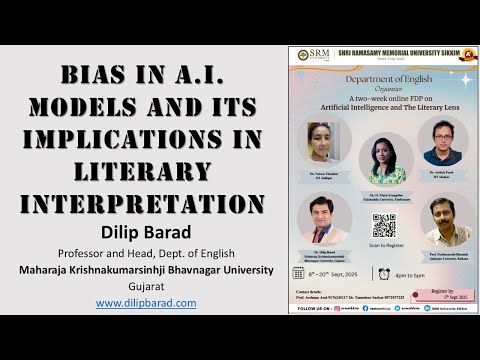
AI Bias and Literary Theory: How Algorithms Replicate Old Stereotypes

AI Bias and Literary Theory: How Algorithms Replicate Old Stereotypes I am writing this blog as an academic task assigned by Prof. Dr. Dilip...