Sunday, January 18, 2026

Between Text and Spectacle: Baz Luhrmann’s The Great Gatsby as Cinematic Adaptation

 Between Text and Spectacle: Baz Luhrmann’s The Great Gatsby as Cinematic Adaptation

I am writing this blog as part of an academic task assigned by Prof. Dr. Dilip Barad, based on a worksheet provided for the critical analysis of The Great Gatsby and its film adaptation The Great Gatsby. The aim of this exercise is to critically examine adaptation as a process by exploring how literary meaning is transformed when translated into a cinematic medium. This blog responds to the key questions and theoretical frameworks outlined in the worksheet and serves as both an academic engagement with adaptation studies and a reflective analysis of a canonical text in a contemporary context.

Introduction

The Great Gatsby (1925) by F. Scott Fitzgerald is one of the most significant literary representations of the American Dream and its disillusionment in the context of the Jazz Age. Set against the backdrop of wealth, excess, and social division, the novel critiques the moral emptiness underlying material success through the tragic figure of Jay Gatsby and the reflective narration of Nick Carraway. Nearly a century later, The Great Gatsby, directed by Baz Luhrmann, reimagines this canonical text for a contemporary audience using spectacle, 3D technology, and a modern soundtrack. Rather than offering a faithful reproduction of the novel, the film raises important questions about adaptation, fidelity, narrative perspective, and cultural translation. This blog undertakes a critical analysis of Luhrmann’s adaptation by examining how the film transforms Fitzgerald’s themes, characters, and symbols—particularly the American Dream—within a modern socio-economic and cinematic context.

Part I: The Frame Narrative and the “Writerly” Text


One of the most significant departures in The Great Gatsby from The Great Gatsby lies in its framing of the narrative. While Fitzgerald’s novel presents Nick Carraway as a reflective narrator looking back on past events from an unspecified point in time, Luhrmann introduces an explicit frame: Nick is shown in a sanitarium, diagnosed with “morbid alcoholism,” where he is encouraged by a doctor to write his memories as a form of therapy. This framing reshapes the act of narration itself and raises important questions about authorship, reliability, and moral authority.

1. The Sanitarium Device: Externalizing or Pathologizing the Narrator

In the novel, Nick Carraway’s narration functions as a quiet moral lens. His reflections emerge from ethical disillusionment rather than psychological collapse. He repeatedly positions himself as observant, restrained, and morally grounded, claiming that he is “inclined to reserve all judgments,” yet gradually arriving at a firm critique of the careless wealthy elite. His narration is introspective but never explicitly unstable.

Luhrmann’s sanitarium device, however, radically recontextualizes this narrative voice. By placing Nick in a clinical space and diagnosing him with “morbid alcoholism,” the film externalizes his internal monologue. What is internal reflection in the novel becomes visible action in the film: writing is no longer an abstract literary process but a therapeutic exercise with a clear cause-and-effect logic. This addition serves the demands of cinema, a medium that often struggles to convey prolonged interiority without visual motivation. The sanitarium provides a narrative justification for voice-over, flashbacks, and the act of writing itself.

At the same time, this device risks pathologizing Nick’s moral perspective. His condemnation of the Buchanans and the East Egg society can now be read not purely as ethical judgment but as the product of trauma, depression, or psychological breakdown. The implication is subtle but significant: Nick’s authority as a moral compass is destabilized. The audience may question whether Gatsby is remembered as he truly was or reconstructed through the fractured psyche of a damaged narrator.

While this framing effectively creates a cinematic structure of memory and recovery, it arguably reduces the novel’s complexity. Fitzgerald allows ambiguity to linger—Nick may be biased, but he is never medically defined. Luhrmann’s approach simplifies this ambiguity by assigning a psychological explanation to Nick’s disillusionment. Thus, the sanitarium device succeeds in translating interior narration into visual causality but does so at the cost of diminishing Nick’s philosophical agency.

2. The “Cinematic Poem” and Floating Text: Bridging or Trapping the Film

Luhrmann further attempts to preserve the novel’s “writerly” quality through the visual superimposition of text. During key moments—most notably the description of the Valley of Ashes—Fitzgerald’s words appear floating across the screen, merging written language with cinematic imagery. Luhrmann has described this technique as “poetic glue” or a “cinematic poem,” suggesting that the film seeks not to abandon literature but to visually honor it.

In the Valley of Ashes sequence, the floating words reinforce the bleakness of the landscape: ash, dust, decay, and spiritual emptiness. The technique momentarily bridges literature and film by reminding viewers that language itself is central to meaning. Instead of merely illustrating the setting, the film foregrounds Fitzgerald’s prose, insisting that the viewer read as well as watch. In this sense, the technique acknowledges the limits of cinema and compensates by borrowing the authority of the written word.

However, this strategy has also been criticized for producing a “noble literalism.” By directly displaying the text, the film risks reducing cinematic interpretation to visual quotation. Rather than allowing meaning to emerge through mise-en-scène, sound, and performance, the film leans on the novel’s language as a guarantee of depth. This creates a quotational quality, where the audience becomes acutely aware of the adaptation as an adaptation. The illusion of diegetic reality is momentarily interrupted, as viewers are pulled out of the narrative world and reminded of the literary source behind it.

As a result, the floating text both connects and confines the film. It bridges the gap between literature and cinema by preserving the novel’s poetic voice, yet it also traps the film within reverence, limiting its autonomy as a visual medium. Instead of fully reimagining Fitzgerald’s imagery, the film sometimes illustrates it, turning cinematic space into a curated exhibition of prose rather than an independent narrative language.

Taken together, the sanitarium frame and the floating text reveal Luhrmann’s central anxiety as an adaptor: how to translate a deeply interior, linguistic novel into a visual spectacle without losing its literary soul. While these techniques successfully externalize internal processes and foreground the importance of language, they also risk simplifying narrative ambiguity and distancing the viewer from the film’s diegetic reality. Part I thus demonstrates how Luhrmann’s adaptation oscillates between innovation and over-insistence, balancing cinematic necessity against literary reverence.

Part II: Adaptation Theory and “Fidelity”


One of the central debates in adaptation studies concerns the question of fidelity—whether a film should remain loyal to the source text or creatively transform it to suit a new medium and audience. Rather than treating fidelity as strict textual obedience, contemporary theorists argue that adaptation involves interpretation, selection, and re-contextualization. Baz Luhrmann’s The Great Gatsby provides a compelling case study for this debate, particularly in its handling of the film’s ending and its controversial use of a modern soundtrack.

3. Hutcheon’s “Knowing” vs. “Unknowing” Audience

Linda Hutcheon defines adaptation as “repetition without replication,” emphasizing that adaptations must function simultaneously for two audiences: the “knowing” audience, familiar with the source text, and the “unknowing” audience, encountering the story for the first time. Luhrmann’s treatment of the film’s ending highlights the difficulty of balancing these two groups.

In The Great Gatsby, the arrival of Henry Gatz at his son’s funeral is a deeply significant moment. Gatsby’s father grounds the myth of Jay Gatsby in the humble reality of James Gatz, revealing the distance between Gatsby’s grand dream and his modest origins. The near-empty funeral exposes the brutal indifference of the elite society that eagerly consumed Gatsby’s wealth but abandoned him in death. For the knowing reader, this scene powerfully reinforces the novel’s social critique, demonstrating how the American Dream ultimately isolates and discards those who attempt to transcend class boundaries.

Luhrmann’s film omits Henry Gatz entirely and eliminates the funeral procession, shifting the emotional focus solely onto Nick Carraway’s loyalty and grief. For the unknowing audience, this omission simplifies the narrative and sharpens its emotional impact. The story becomes more intimate, centering on friendship, betrayal, and lost ideals rather than social abandonment. Gatsby’s isolation appears personal rather than systemic, the result of misplaced love rather than class exploitation.

However, for the knowing audience, this alteration significantly reshapes the meaning of Gatsby’s isolation. Without his father’s presence, Gatsby remains an almost mythic figure, detached from his origins and social reality. The critique of class hypocrisy is softened, and the narrative moves away from social tragedy toward tragic romance. This shift suggests that Luhrmann prioritizes emotional accessibility and narrative clarity for unknowing viewers, even if it means diluting the novel’s broader socio-economic critique. In this sense, fidelity is redirected—from social realism to emotional immediacy.

4. Alain Badiou and the “Truth Event”

The question of fidelity can also be approached philosophically through the work of Alain Badiou, who argues that truth emerges through radical rupture or “Truth Events” moments that disrupt established cultural and ideological structures. Scholar U. Vooght applies this framework to adaptation studies, suggesting that a film may be faithful not to the literal details of a text, but to the disruptive energy it once represented.

Luhrmann’s use of hip-hop music instead of period Jazz exemplifies this approach. In the 1920s, Jazz was considered dangerous, rebellious, and morally threatening. Over time, however, Jazz has been canonized and stripped of its subversive force. To rely solely on period music in a contemporary film risks aesthetic nostalgia rather than cultural shock.

By incorporating hip-hop, an equally disruptive and politically charged genre, Luhrmann attempts an act of intersemiotic translation, translating the cultural impact of Jazz into a modern sonic language. For contemporary audiences, hip-hop carries associations of excess, rebellion, ambition, and social mobility, echoing the emotional energy of Fitzgerald’s Jazz Age rather than its historical soundscape.

From this perspective, the anachronistic soundtrack can be read as an act of deeper fidelity to the novel’s Truth Event rather than its historical specificity. However, this strategy is not without consequence. While it successfully recreates cultural rupture, it simultaneously destabilizes the film’s historical realism, potentially alienating viewers seeking period authenticity. The soundtrack thus embodies the central paradox of adaptation: fidelity to spirit often requires betrayal of form.

Part II demonstrates that Luhrmann’s adaptation redefines fidelity as experiential equivalence rather than textual accuracy. By reshaping the ending to appeal to unknowing audiences and by translating Jazz into hip-hop as a modern Truth Event, the film prioritizes emotional resonance and cultural relevance over historical precision. These choices reveal adaptation not as a process of loss, but as one of strategic transformation—where meaning survives by changing form.

Part III: Characterization and Performance

Characterization is one of the most revealing areas in which the shift from novel to film becomes visible. While The Great Gatsby relies on gradual revelation and moral ambiguity, The Great Gatsby must condense, visualize, and emotionally anchor its characters for a contemporary audience. As a result, the film’s performances—especially those of Gatsby and Daisy—play a crucial role in reshaping the novel’s ethical framework.

5. Gatsby: Romantic Hero vs. Criminal

In Fitzgerald’s novel, Gatsby’s criminality is revealed slowly and indirectly. Rumors circulate at his parties, ambiguous phone calls interrupt his conversations, and only gradually does the reader learn that his fortune is built on bootlegging and bond fraud. This delayed disclosure is central to the novel’s critique: Gatsby’s dream is not merely idealistic but morally compromised. The “foul dust” that floats in the wake of his dreams is the result of his own choices, suggesting that his downfall is self-generated rather than imposed from outside.

Luhrmann’s film significantly softens this aspect of Gatsby’s character. Several moments that explicitly point to criminal activity—such as the call from Detroit or Philadelphia revealing bond fraud—are either deleted, delayed, or framed less ominously. Instead of emphasizing illegality, the film foregrounds Gatsby’s emotional vulnerability and romantic longing. This shift is reinforced by Leonardo DiCaprio’s performance, which presents Gatsby as intensely hopeful, emotionally transparent, and almost childlike in his devotion to Daisy.

The film’s visual splendor further amplifies this transformation. Luhrmann’s “Red Curtain” style—marked by fireworks, orchestral swells, sweeping crane shots, and saturated color—wraps Gatsby in an aura of mythic grandeur. This spectacle often overwhelms the novel’s critique of the “corrupted dream.” Rather than appearing as a man who willingly compromises ethics for illusion, Gatsby is framed as a tragic victim of circumstance: a self-made outsider destroyed by an unforgiving class system and an unattainable love.

As a result, the film shifts responsibility away from Gatsby’s delusions and toward external forces such as Tom Buchanan’s brutality and Daisy’s weakness. The tragic dimension remains, but its moral complexity is reduced. Gatsby’s dream no longer collapses under the weight of its own corruption; instead, it is crushed by social forces beyond his control.

6. Daisy Buchanan: Reconstructing Desire and Agency


In the novel, Daisy Buchanan is often interpreted as careless, shallow, and morally evasive. Her famous declaration that she hopes her daughter will be “a beautiful little fool” encapsulates both her awareness of patriarchal limitation and her emotional detachment. Fitzgerald presents Daisy as someone who chooses comfort and class security over emotional risk, making her complicit in Gatsby’s destruction.

Luhrmann’s adaptation reconstructs Daisy to align with contemporary expectations of romantic plausibility. One of the most telling changes is the removal of scenes emphasizing Daisy’s lack of maternal instinct. The child, who functions symbolically in the novel as evidence of Daisy’s emotional emptiness, is largely absent from the film. By eliminating this dimension, Daisy appears less careless and more emotionally constrained by circumstance.

The film also intensifies Tom Buchanan’s violence and dominance, positioning Daisy as trapped within an oppressive marriage. Carey Mulligan’s performance emphasizes fragility, hesitation, and emotional confusion. This portrayal invites sympathy but simultaneously diminishes Daisy’s agency. Her final decision to retreat into Tom’s wealth appears less like a calculated class choice and more like a fearful response to emotional pressure.

By softening Daisy’s moral responsibility, the film ensures that Gatsby remains the uncontested romantic hero. Daisy becomes less an autonomous moral actor and more a symbolic object of desire—an ideal onto which Gatsby projects meaning. This reconstruction makes Gatsby’s obsession emotionally credible for a 21st-century audience, but it also simplifies Fitzgerald’s critique of privilege, gender, and moral complicity.

Part III reveals how performance and visual style reshape the ethical balance of The Great Gatsby. By romanticizing Gatsby and softening Daisy, Luhrmann’s adaptation shifts the narrative away from moral ambiguity toward emotional identification. The film privileges pathos over critique, transforming a story about self-deception and social corruption into a tragic romance driven by innocence betrayed. While this strategy enhances emotional accessibility, it comes at the cost of the novel’s sharper moral edge.

Part IV: Visual Style and Socio-Political Context

One of the most distinctive aspects of The Great Gatsby is its highly stylized visual language. Drawing from his well-known “Red Curtain” aesthetic, Baz Luhrmann embraces theatricality, excess, and sensory overload as a means of storytelling. These stylistic choices are not merely decorative; they actively shape the film’s ideological engagement with wealth, class, and the American Dream. When read alongside the socio-economic context of the film’s post-2008 release, the visual style acquires renewed political resonance.

7. The “Red Curtain” Style and the Party Scene: Critique or Celebration ?


Luhrmann’s party scenes are the most explicit expressions of the Red Curtain style. Characterized by vortex-like camera movements, rapid montage editing, booming music, and immersive 3D visuals, these sequences overwhelm the spectator. The intent is to convey what Nick Carraway describes in the novel as “an orgastic future”—a world intoxicated by money, speed, and sensory pleasure.

From a critical perspective, these techniques can be read as a visual critique of excess. The relentless motion of the camera mirrors the moral chaos of the Jazz Age elite. The absence of stillness suggests a society incapable of reflection or ethical restraint. The parties feel less like celebrations and more like spectacles on the verge of collapse, reinforcing Fitzgerald’s portrayal of wealth as hollow and unsustainable.

However, the same techniques also risk celebrating the very consumerism they seek to critique. The 3D technology immerses viewers directly into the spectacle, inviting participation rather than distance. The lavish costumes, champagne fountains, and choreographed chaos are visually intoxicating. Instead of alienating the audience from excess, the film often seduces them. Viewers are encouraged to marvel at the luxury rather than recoil from it, becoming spectators—and participants—in Gatsby’s fantasy.

This ambiguity reveals a tension at the heart of Luhrmann’s adaptation. While the Red Curtain style aims to expose the grotesque nature of wealth, its aesthetic pleasure risks undermining its moral critique. The film thus mirrors the contradiction of the American Dream itself: dazzling in appearance, destructive in consequence.

8. The American Dream in Crisis: 1925 vs. Post-2008


The release of The Great Gatsby in 2013—five years after the global financial crisis—inevitably reframes Fitzgerald’s critique of the American Dream. Luhrmann has described the relevance of the story in terms of the “moral rubberiness” of Wall Street, drawing an implicit parallel between the speculative excess of the 1920s and the financial recklessness that led to the 2008 collapse.

In this context, the film’s depiction of the Green Light takes on renewed significance. In the novel, the Green Light symbolizes hope, aspiration, and the possibility of self-reinvention. In the film, however, it is visually emphasized as distant, faint, and perpetually receding. The repeated imagery suggests not just the difficulty of achieving the dream, but its fundamental impossibility. The dream is visible but structurally unattainable—an illusion sustained by belief rather than reality.

Similarly, the Valley of Ashes functions as a powerful visual metaphor for post-2008 economic inequality. No longer merely an industrial wasteland, it evokes the social consequences of unchecked capitalism: abandoned labour, environmental decay, and invisible suffering. The stark contrast between Gatsby’s glowing mansion and the grey desolation of the Ashes reflects a world divided between excess and exclusion—the “1%” and the forgotten masses.

Together, these symbols suggest that the film emphasizes the impossibility of the dream more than the glamour of its pursuit. While Luhrmann’s visuals continue to romanticize aspiration, the narrative ultimately exposes the dream as hollow and rigged. The American Dream in 2013 is not simply failed; it is revealed as a spectacle that sustains itself by obscuring the cost paid by those left behind.

Part IV demonstrates how Luhrmann’s visual style and historical context reshape the ideological core of The Great Gatsby. The Red Curtain aesthetic both critiques and indulges in excess, reflecting the contradictions of consumer capitalism. When read against the backdrop of the post-2008 financial crisis, the film reframes the American Dream as an alluring but unattainable fantasy—one that dazzles the eye while concealing its structural injustices. In doing so, Luhrmann’s adaptation transforms Fitzgerald’s Jazz Age warning into a modern parable of economic illusion.

Part V: Creative Response – The Plaza Hotel Confrontation

As the scriptwriter adapting the Plaza Hotel confrontation scene, the central challenge lies in translating one of the novel’s most psychologically charged moments into a visually compelling cinematic sequence. In The Great Gatsby, this confrontation is largely verbal and psychological, exposing the fragile foundations of Gatsby’s dream without overt physical violence. The question is whether Baz Luhrmann’s addition—Gatsby losing his temper and nearly striking Tom—should be retained.

Decision: I Would Keep the Film’s Addition

I would retain Gatsby’s loss of temper and near-violent outburst, prioritizing fidelity to the medium over strict fidelity to the book’s character consistency.

Justification: Fidelity to the Medium (Dramatic Tension)

In the novel, the Plaza Hotel scene unfolds as a battle of words and revelations. Gatsby’s composure cracks subtly; Fitzgerald writes that he looks “as if he had killed a man,” suggesting an internal collapse rather than an external explosion. This restraint aligns with Gatsby’s character as a man who lives through illusion, control, and performance. However, what works effectively in prose does not always translate with equal force to cinema.

Film is a visual and kinetic medium that relies on externalized emotion. Luhrmann’s The Great Gatsby builds Gatsby as a tightly controlled figure—polite, hopeful, and obsessively disciplined in maintaining his persona. For the dramatic arc to reach a climax, this carefully constructed façade must visibly fracture. Gatsby’s near-violent outburst functions as that rupture.

This moment marks the symbolic death of the “Great” Gatsby. When he loses control, the fantasy collapses in front of Daisy, Tom, and the audience. The gesture visually confirms Tom’s accusations that Gatsby is a fraud and terrifies Daisy, pushing her back toward the security of old money. In cinematic terms, this is the point of no return—the dream can no longer sustain itself.

Balancing Character and Spectacle

While this addition deviates from Fitzgerald’s subtle characterization, it does not entirely betray Gatsby’s inner truth. The outburst can be read as the inevitable consequence of prolonged repression—class anxiety, emotional desperation, and the unbearable pressure of sustaining illusion. Rather than transforming Gatsby into a violent man, the scene exposes the emotional volatility beneath his romantic idealism.

Thus, the change shifts the scene from psychological dismantling to visual catastrophe, aligning with Luhrmann’s broader aesthetic strategy. The Plaza confrontation becomes not just a turning point in the narrative, but a cinematic spectacle that signals the irreversible collapse of Gatsby’s dream.

By retaining Gatsby’s near-violent outburst, the adaptation prioritizes dramatic clarity and emotional immediacy over textual subtlety. This choice reflects a conscious fidelity to the cinematic medium, where inner collapse must be made visible. While it simplifies the novel’s ambiguity, it provides a powerful visual articulation of Gatsby’s downfall, ensuring that the emotional stakes of the scene resonate forcefully with a contemporary audience. In this moment, fidelity to the medium becomes a means of preserving the tragic core of the story, even at the cost of literary restraint.

Conclusion

Baz Luhrmann’s The Great Gatsby is a visually extravagant and interpretative adaptation of The Great Gatsby that prioritizes cinematic spectacle and emotional immediacy over strict textual fidelity. By reframing the narrative through the sanitarium, employing a modern soundtrack, and embracing the theatrical “Red Curtain” style, the film redefines fidelity as experiential rather than literal. Although these choices soften Fitzgerald’s sharp social critique and moral ambiguity, they successfully translate the restless energy, excess, and eventual collapse of the American Dream for a post-2008 audience. Ultimately, the film functions not as a replication of the novel but as a cultural reinterpretation—one that reveals both the creative potential and the inevitable limitations of adapting a canonical literary text for a contemporary visual medium.

References

  • Fitzgerald, F. Scott. The Great Gatsby. Charles Scribner’s Sons, 1925.
  • Hutcheon, Linda. A Theory of Adaptation. Routledge, 2006.
  • Luhrmann, Baz, director. The Great Gatsby. Warner Bros. Pictures, 2013.
  • Perdikaki, Katerina. “Film Adaptation as the Interface between Creative Translation and Cultural Transformation.” The Journal of Specialised Translation, no. 29, 2018, pp. 1–18.
  • Vooght, U. “The Great Gatsby Meets Alain Badiou: The Truth Event in Adaptation.” Adaptation Studies Review, 2023.

Sunday, January 11, 2026

Understanding The Waste Land through Upanishadic and Buddhist Thought

 Understanding The Waste Land through Upanishadic and Buddhist Thought

I am writing this blog to study T. S. Eliot’s The Waste Land through the perspective of Indian Knowledge Systems, especially Upanishadic and Buddhist philosophy, which play a crucial role in the poem’s structure and conclusion. Although the poem is usually read as a modernist response to Western spiritual crisis, this blog aims to show how Eliot turns to Indian philosophical ideas such as renunciation, self-control, compassion, and inner peace to respond to that crisis. By engaging with scholarly articles and study material, I attempt to explain how concepts like Datta, Dayadhvam, Damyata, the Fire Sermon, and the mantra Shantih are not ornamental references but meaningful ethical and spiritual frameworks. This blog is written to make these complex ideas accessible to students and to highlight how ancient Indian wisdom helps deepen our understanding of modernist despair and the possibility of spiritual renewal in The Waste Land.

Introduction

The Waste Land by T. S. Eliot is one of the most challenging and influential poems of twentieth-century English literature, known for its fragmented structure, multiple voices, and intense portrayal of spiritual emptiness in modern life. Written in the aftermath of the First World War, the poem reflects a civilization marked by disillusionment, moral decay, and loss of meaning. While critics often approach the poem through Western myths, classical texts, and modernist techniques, Eliot also turns toward Indian Knowledge Systems, especially Upanishadic and Buddhist philosophy, to articulate a response to this cultural crisis. Concepts such as renunciation, self-control, compassion, and inner peace—expressed through references like Datta, Dayadhvam, Damyata, the Fire Sermon, and the closing mantra “Shantih Shantih Shantih”—offer a spiritual framework that contrasts with the poem’s depiction of desolation. This introduction sets the foundation for reading The Waste Land as a dialogue between Western modernist despair and ancient Indian wisdom traditions that gesture toward ethical discipline and spiritual renewal.

Indian Knowledge Systems and Spiritual Regeneration in The Waste Land


A Summary of “Reflection of Hindu and Buddhist Philosophy in T. S. Eliot’s The Waste Land”


1. Indian Knowledge Systems as the Foundation of Eliot’s Vision

The article argues that The Waste Land is deeply shaped by Indian Knowledge Systems, especially Hindu and Buddhist philosophy, which Eliot encountered through serious academic study at Harvard. Under the guidance of scholars such as Irving Babbitt and Charles Rockwell Lanman, Eliot studied Sanskrit, Pali, the Upanishads, the Vedas, and Buddhist scriptures. These traditions influenced his understanding of ethics, spiritual discipline, and human suffering, preparing the intellectual ground on which The Waste Land was written. Indian philosophy, therefore, becomes a vital source through which Eliot seeks a universal moral vision rather than a narrowly Western one

2. The Waste Land as a Diagnosis of Spiritual Drought

According to the article, Eliot presents modern Western civilization as a spiritually barren landscape, exhausted by materialism, lust, and moral indifference. This condition mirrors key ideas in Indian thought, where spiritual ignorance leads to suffering and decay. In The Burial of the Dead, images of dryness and lifelessness represent this spiritual vacuum, while the possibility of rain suggests renewal through self-realization and inner awakening, a core concern of Indian Knowledge Systems

3. Moral Breakdown and the Loss of Discipline

The article interprets A Game of Chess as a critique of modern life’s mechanical relationships and moral emptiness. Sexuality, once sacred in Indian philosophical understanding, is reduced to mere physical indulgence. This degeneration contrasts sharply with Hindu and Buddhist emphasis on self-control (sanyam), ethical responsibility, and balance between desire and duty. The section demonstrates how the absence of spiritual discipline results in emotional alienation and social breakdown

4. Buddhist Thought and the Fire of Desire

The discussion of The Fire Sermon highlights Eliot’s direct engagement with Buddhist philosophy, particularly the Adittapariyaya Sutta. In Buddhism, desire is described as a burning force that binds human beings to suffering. The article shows how Eliot uses fire imagery to represent unchecked passion and sensory obsession in modern society. The Buddhist principle of non-attachment emerges as a path toward liberation, aligning Eliot’s poetic vision with the ethical core of Indian Knowledge Systems

5. Upanishadic Ethics and the Voice of the Thunder

The final section, What the Thunder Said, is read as the poem’s most explicit engagement with Upanishadic wisdom. The thunder’s command—Datta (Give), Dayadhvam (Sympathize), and Damyata (Control)—originates from the Brihadaranyaka Upanishad and offers a moral framework for restoring human values. These teachings address egoism, cruelty, and excess, suggesting that spiritual regeneration depends on ethical action rooted in ancient Indian thought

6. Shantih and the Universal Ideal of Peace

The repetition of “Shantih Shantih Shantih” at the end of the poem is interpreted as a Vedic prayer for peace—internal, cosmic, and social. The article emphasizes that this ending transforms The Waste Land from a poem of despair into one of spiritual possibility, reinforcing the relevance of Indian Knowledge Systems as a source of harmony and healing in a fractured modern world

The article concludes that The Waste Land is not merely a Western modernist text but a cross-cultural synthesis in which Indian Knowledge Systems play a crucial role. By integrating Hindu and Buddhist philosophies, Eliot offers a universal response to modern spiritual crisis, showing that ancient Indian wisdom continues to provide ethical and spiritual guidance for contemporary humanity

Upanishadic Philosophy and the Modern Spiritual Crisis in The Waste Land

An Expanded Summary of Dr. Manoj Kr. Nanda’s “The Upanishadic Elements in T. S. Eliot’s The Waste Land”

1. Indian Knowledge Systems as an Interpretative Framework

The article situates The Waste Land within the broader intellectual tradition of Indian Knowledge Systems, arguing that Upanishadic philosophy provides a crucial interpretative framework for understanding the poem’s spiritual depth. Although Eliot does not explicitly quote the Upanishads throughout the poem, their philosophical presence is felt in its treatment of reality, selfhood, suffering, and redemption. The author emphasizes that Eliot’s modernist concerns—fragmentation, loss of meaning, and existential anxiety—find striking parallels in the Upanishadic diagnosis of human suffering caused by ignorance (avidya) and illusion (maya)

Rather than reading the poem as a purely Western response to post–World War I disillusionment, the article argues that Eliot turns to ancient Indian wisdom to universalize the crisis of modernity. Indian Knowledge Systems thus function not as cultural ornaments but as philosophical tools through which Eliot critiques modern civilization and imagines the possibility of spiritual renewal.

2. Spiritual Desolation and the Illusion of the Material World

One of the central arguments of the article is that the spiritual barrenness depicted in The Waste Land mirrors the Upanishadic view of the material world as transient, illusory, and ultimately unsatisfying. Images such as the “dead land,” “dead tree,” and the “Unreal City” represent a world cut off from spiritual awareness. According to the Upanishads, attachment to the material realm without self-knowledge leads to suffering, a condition vividly dramatized in Eliot’s portrayal of modern life

The article draws attention to The Burial of the Dead, where seasonal imagery subverts traditional associations of spring with rebirth. This inversion reflects the Upanishadic insight that external change alone cannot bring spiritual renewal unless accompanied by inner awakening. Thus, Eliot’s barren landscapes are not merely historical symbols but metaphysical representations of humanity’s alienation from higher truth.

3. Fragmentation, Identity Crisis, and the Divided Self

Dr. Nanda interprets Eliot’s fragmented structure and multiple voices as symbolic of a divided and disintegrated self, a condition that resonates with Upanishadic discussions of false individuality. The poem’s lack of narrative coherence reflects humanity’s loss of spiritual unity. In contrast, the Upanishads emphasize the realization of the oneness of Atman (the individual self) with Brahman (the ultimate reality) as the foundation of peace and liberation

From this perspective, modernist fragmentation is not simply an aesthetic experiment but a philosophical condition. Eliot’s poetic form mirrors the inner confusion of a civilization that has lost touch with spiritual knowledge. Indian Knowledge Systems thus help explain why fragmentation dominates the poem and why unity remains elusive.

4. The Quest for Knowledge and Transcendence

The article further interprets The Waste Land as a spiritual journey, moving through disillusionment toward the possibility of enlightenment. This trajectory aligns closely with the Upanishadic emphasis on self-knowledge (vidya) as the path to liberation (moksha). The poem’s movement through despair, moral decay, and existential questioning reflects the seeker’s struggle in Indian philosophical traditions

In The Fire Sermon, the reference to Buddhist teachings on desire complements the Upanishadic call for detachment from worldly attachments. The poem exposes how lust, greed, and sensory obsession prevent spiritual insight, reinforcing the Indian philosophical belief that liberation requires discipline, renunciation, and inner awareness.

5. Water Symbolism and the Promise of Renewal

A major contribution of the article lies in its detailed discussion of water imagery, which is closely connected to Indian Knowledge Systems. In the Upanishads, water symbolizes purification, divine wisdom, and spiritual regeneration. Eliot’s repeated emphasis on dryness and the absence of water signifies a state of spiritual drought, while the anticipation of rain suggests the possibility of renewal through enlightenment

The article argues that rain in The Waste Land is not merely a natural phenomenon but a metaphor for spiritual grace and knowledge. Just as water sustains physical life, spiritual knowledge sustains inner life. Eliot’s use of this imagery demonstrates his engagement with Upanishadic symbolism to express hope amid despair.

6. Death, Rebirth, and Cyclical Existence

Drawing upon Upanishadic concepts of rebirth and cyclicality, the article interprets the poem’s obsession with death as a transitional phase rather than an absolute end. In Indian philosophy, death is a passage toward transformation, and liberation lies beyond the cycle of birth and rebirth (samsara). This idea surfaces strongly in What the Thunder Said, where destruction and chaos coexist with the promise of renewal

The thunder’s utterance—Datta, Dayadhvam, Damyata—is read as the ethical core of the poem, drawn from the Brihadaranyaka Upanishad. These commands promote generosity, compassion, and self-control as practical spiritual disciplines necessary for regeneration, linking Indian Knowledge Systems directly to Eliot’s moral vision.

7. Upanishadic Imagery as a Critique of Modern Materialism

The article also emphasizes Eliot’s use of Upanishadic imagery to critique modern materialism. Symbols such as the “dry stone” reflect spiritual rigidity and emotional sterility, while references to truth (Satyam) and Eastern spiritual practices challenge the dominance of material progress. Through these images, Eliot questions the adequacy of modern civilization’s values and gestures toward ancient wisdom as a corrective force

 Indian Knowledge Systems and Universal Meaning

In conclusion, the article asserts that The Waste Land should be read as a dialogue between modernist despair and Upanishadic wisdom. By integrating Indian Knowledge Systems into his poetic vision, Eliot transforms the poem into a universal meditation on suffering, ignorance, and the possibility of spiritual renewal. The Upanishads enrich the poem’s thematic complexity and demonstrate how ancient Indian philosophy remains relevant for interpreting modern crises. Eliot’s work thus emerges not merely as a record of cultural decay but as a profound search for transcendence grounded in timeless spiritual traditions.

Conclusion

This blog has examined The Waste Land as a modernist poem deeply enriched by Indian Knowledge Systems, particularly Upanishadic and Buddhist philosophy, which offer a meaningful response to the spiritual crisis of the modern world. Rather than using Eastern ideas as mere exotic references, T. S. Eliot integrates them into the ethical and philosophical core of the poem. Concepts such as renunciation, non-attachment, self-control, compassion, and inner peace emerge as counterforces to the fragmentation, moral decay, and spiritual drought that define the Waste Land. Through symbols like fire and water, teachings such as Datta, Dayadhvam, Damyata, and the concluding mantra “Shantih Shantih Shantih,” Eliot draws upon ancient Indian wisdom to imagine the possibility of regeneration beyond despair. Reading the poem through the lens of Indian Knowledge Systems thus reveals The Waste Land not only as a document of modern disillusionment but also as a cross-cultural text that gestures toward ethical discipline, spiritual awareness, and universal peace, affirming the continuing relevance of Indian philosophy in understanding both literature and modern human experience.

References

  • Chahal, Paramveer. “Reflection of Hindu and Buddhist Philosophy in T. S. Eliot’s The Waste Land.” Paripex – Indian Journal of Research, vol. 12, no. 6, June 2023, pp. 11–14. DOI: 10.36106/paripex.
  • Nanda, Manoj Kr. “The Upanishadic Elements in T. S. Eliot’s The Waste Land.” International Journal of Creative Research Thoughts (IJCRT), vol. 12, no. 9, Sept. 2024, ISSN 2320-2882, pp. c932–c935.

“Homebound (2025): Dignity, Displacement, and the Illusion of Belonging”

 Homebound (2025): Dignity, Displacement, and the Illusion of Belonging

This blog is written as part of an academic task assigned by Barad Sir for our Film Studies / Sociology of Media course. Based on a detailed worksheet provided for the film Homebound (2025), the blog engages with the film as an academic text by analyzing its narrative, characters, cinematic techniques, and the social issues it represents, with the aim of developing critical thinking and understanding how cinema reflects and questions lived social realities.

Introduction


Homebound, directed by Neeraj Ghaywan, is a socially grounded film that explores questions of dignity, belonging, and citizenship against the backdrop of contemporary India. Set around the COVID-19 lockdown, the film follows two young men whose aspirations for stability and respect collide with entrenched structures of caste, religion, and institutional indifference. Rather than presenting dramatic spectacle, Homebound adopts a realist mode, focusing on everyday gestures, silences, and bodies in motion to reveal how systemic inequality operates in ordinary life.

This blog approaches Homebound as an academic text, reading it not only as a story of physical migration during the pandemic, but also as a metaphorical journey toward acceptance that ultimately remains incomplete. By engaging with the film’s narrative structure, character arcs, and cinematic language, the discussion aims to understand how Homebound exposes the gap between constitutional promises and lived realities, and how cinema can become a powerful medium for questioning social apathy and denied dignity.

PART I: PRE-SCREENING CONTEXT & ADAPTATION

1. Source Material Analysis


Homebound is adapted from Basharat Peer’s 2020 New York Times essay about Amrit Kumar and Mohammad Saiyub, two migrant textile workers caught in the sudden lockdown exodus. In the original article, the narrative centers on their labouring lives, survival struggles, and the collapse of economic security when the pandemic hit.

In the film, director Neeraj Ghaywan fictionalizes these figures as Chandan and Shoaib, but importantly reframes them as aspiring police constables instead of textile workers. This shift is not superficial—it recalibrates the film’s core inquiry from mere economic precarity to the politics of ambition and institutional dignity.

Why this matters:

  • In the essay, dignity is threatened by market collapse and employer exploitation.

  • In the film, dignity is imagined as something that can be earned through entry into a state institution—the police.

  • The uniform symbolizes not just a job, but social respect, safety, and hope for legitimacy in a society that otherwise marginalizes them.

Thus, the film moves beyond documenting hardship to questioning why institutional membership is seen as the only path to dignity for the marginalized—a commentary absent from the original reportage’s narrower focus on labour conditions.

2. Production Context: The Scorsese Influence


The film lists Martin Scorsese as an Executive Producer, and this collaboration significantly shapes its aesthetic and narrative sensibility.

How Scorsese’s influence shows:

  • A realist tone that avoids melodrama and relies on naturalistic performances.

  • Observational editing—long takes that create space for silence and emotional restraint.

  • An avoidance of overt musical cues, letting the world of the film feel unfiltered.

This style aligns Homebound with international art cinema traditions, which helped its warm reception at festivals like Cannes Film Festival and Toronto International Film Festival. Western cinephile audiences often appreciate this kind of disciplined realism.

However, for many domestic Indian viewers, the lack of dramatic closure and overt emotional cues posed a challenge. In mainstream Indian cinema, emotional arcs are often more pronounced, and audiences are conditioned toward a narrative rhythm that Homebound intentionally resists. The result is a film that is critically acclaimed globally but harder for some home audiences to digest emotionally.

PART II: NARRATIVE STRUCTURE & THEMATIC STUDY

3. The Politics of the “Uniform”


In the first half of Homebound, the narrative closely follows Chandan and Shoaib as they prepare for the police entrance examination. For both protagonists, the police uniform represents far more than employment—it symbolizes social mobility, respectability, and protection. In a society where caste and religion determine everyday treatment, the uniform promises visibility without vulnerability.

Chandan and Shoaib believe that the state institution of the police operates on fairness and merit. However, the film deliberately exposes the fragility of this belief by foregrounding the sheer imbalance of opportunity: 2.5 million applicants competing for only 3,500 seats. This statistic is not merely informational; it becomes a narrative device that reveals how meritocracy often functions as an illusion. The film suggests that ambition is encouraged among the marginalized, but structural bottlenecks ensure that very few can ever succeed. In doing so, Homebound critiques how hope itself becomes a form of quiet discipline within unequal systems.

4. Intersectionality: Caste and Religion

Rather than depicting explicit acts of violence, Homebound focuses on micro-aggressions—small, everyday moments that reveal deep-seated prejudice.

Case A: Caste and Internalized Shame
Chandan’s decision to apply under the ‘General’ category instead of the ‘Reserved’ category reveals the stigma attached to caste identity. His choice reflects an internalized fear that even institutional success will not shield him from judgment. The scene highlights how caste discrimination often operates invisibly, producing shame and self-erasure rather than confrontation.

Case B: Religious Othering and Quiet Cruelty
In a workplace scene, an employee refuses to accept a water bottle from Shoaib. There is no verbal insult, yet the act functions as a clear marker of exclusion. This moment exemplifies “quiet cruelty”—a form of discrimination that is socially normalized and therefore rarely questioned. The film shows how religious othering persists in polite, everyday interactions, making it both pervasive and difficult to challenge.

5. The Pandemic as Narrative Device


The arrival of the COVID-19 lockdown in the second half of the film marks a significant tonal shift. Rather than feeling like a convenient narrative twist, the pandemic functions as an inevitable exposure of what scholars describe as “slow violence”—systemic harm that exists long before crisis but becomes visible only during catastrophe.

The lockdown transforms Homebound from a drama of ambition into a survival thriller. Aspirations tied to exams, uniforms, and institutions collapse, replaced by the basic struggle to remain alive. The road journey undertaken by the protagonists reveals that the violence they face during the pandemic is not new; it is simply the intensified version of the neglect they already endured. In this way, the film argues that the pandemic does not create inequality—it merely unmasks it.

PART III: CHARACTER & PERFORMANCE ANALYSIS

6. Somatic Performance (Body Language): Chandan

Vishal Jethwa’s performance as Chandan is marked by a powerful use of somatic acting, where the body communicates trauma more forcefully than dialogue. Reviewers have noted that Chandan appears to physically “shrink” when confronted by authority figures. This is most evident in the scene where he is asked to state his full name. His shoulders curl inward, his gaze drops, and his voice hesitates—suggesting a lifetime of learned caution.

This physical contraction reflects the internalized trauma of the Dalit experience, where the body instinctively anticipates judgment and humiliation. Jethwa’s performance shows how caste oppression is not only external but deeply embodied. The hesitation around naming oneself becomes a moment of existential vulnerability, where identity itself feels like a risk rather than a right.

7. The “Othered” Citizen: Shoaib

Ishaan Khatter portrays Shoaib with a restrained intensity often described as “simmering angst.” Unlike overt rage, his frustration remains controlled, surfacing in clenched jaws, silences, and sudden emotional withdrawals. This performance choice reflects the reality of minorities who must constantly regulate their emotions to remain socially acceptable.

Shoaib’s character arc—from rejecting a job opportunity in Dubai to pursuing a government position in India—reveals a deep desire for belonging within the nation. His choice signals faith in the idea of India as home, even as lived experiences repeatedly mark him as an outsider. The film thus captures the paradox faced by minority communities: the emotional pull of home exists alongside the constant experience of being “othered” within it.

8. Gendered Perspectives: Sudha Bharti


Janhvi Kapoor’s portrayal of Sudha Bharti has been critiqued by some as functioning more as a narrative device than a fully realized character. While this criticism holds weight—her interior conflicts are less explored—her presence serves an important thematic function.

Sudha represents educational empowerment and social privilege, demonstrating how access to education can offer a comparatively stable path to dignity. Her character operates as a counterpoint to Chandan and Shoaib, revealing that effort alone does not determine outcomes; access and insulation matter. Rather than undermining the narrative, her limited development reinforces the film’s critique of structural inequality by highlighting who is allowed to imagine a future without fear.

PART IV: CINEMATIC LANGUAGE

9. Visual Aesthetics


Cinematographer Pratik Shah employs a deliberately warm, grey, and dusty color palette that visually mirrors the emotional and physical fatigue experienced by the characters. During the highway migration sequences, the framing avoids wide, scenic shots and instead favors tight close-ups of feet, dirt-stained clothes, sweat, and strained faces. These visual choices deny the audience any sense of cinematic distance or relief.

By focusing on fragmented body parts rather than whole bodies, the film constructs what can be described as an “aesthetic of exhaustion.” The repeated emphasis on feet dragging across hot asphalt, sweat mixing with dust, and labored breathing transforms movement into suffering. The road ceases to be a symbol of freedom or transition; instead, it becomes a site of relentless endurance. This visual strategy prevents romanticization and forces viewers to confront the sheer physical cost of survival.

10. Soundscape

The background score by Naren Chandavarkar and Benedict Taylor adopts a minimalist approach that relies heavily on silence and ambient sound. Instead of guiding emotional responses through swelling music, the film allows long stretches of quiet to dominate—punctuated only by footsteps, traffic hums, or labored breathing.

This restraint sharply contrasts with traditional Bollywood melodramas, where tragedy is often underscored by overt musical cues designed to elicit immediate emotional reactions. In Homebound, silence becomes an ethical choice. It respects the gravity of suffering without aestheticizing it. By refusing emotional manipulation, the soundscape aligns with the film’s realist politics, allowing tragedy to register as lived experience rather than cinematic spectacle.

PART V: CRITICAL DISCOURSE & ETHICS (POST-SCREENING SEMINAR)


11. The Censorship Debate

The Central Board of Film Certification ordered 11 cuts in Homebound, including the muting of the word “Gyan” and the removal of a dialogue referencing “aloo gobhi.” While seemingly minor, these cuts are deeply symbolic. They point to the state’s anxiety about everyday markers of identity—names, food habits, and casual speech—that subtly expose caste and communal fault lines.

Rather than censoring explicit political critique, the CBFC targets ordinary social details, revealing discomfort with cinema that foregrounds structural inequality as a lived, routine experience. Actor Ishaan Khatter criticized this as a case of “double standards,” noting that social films are subjected to greater scrutiny than mainstream spectacles. His statement highlights how realism itself becomes threatening when it reflects society too accurately.

12. The Ethics of “True Story” Adaptations

The film’s ethical standing has been questioned following a plagiarism lawsuit filed by Puja Changoiwala and claims that the family of Amrit Kumar—one of the real-life figures—was unaware of the film’s release and allegedly compensated inadequately. These controversies raise pressing ethical concerns about authorship, consent, and representation.

When filmmakers adapt stories of the marginalized, they carry a responsibility not only to raise awareness but also to ensure acknowledgment, transparency, and fair inclusion. Homebound complicates its moral authority by risking the reproduction of the same silencing it seeks to critique. The debate forces us to ask whether awareness alone is sufficient, or whether ethical storytelling must also involve accountability to the lives being represented.

13. Commercial Viability vs. Art


Despite international acclaim—including a standing ovation at Cannes and an Oscar shortlist—Homebound struggled at the domestic box office. Producer Karan Johar publicly stated that he might not make similarly “unprofitable” films again, underscoring the economic risks of serious social cinema.

This contrast exposes a fundamental tension in the post-pandemic Indian film market: while global audiences and festivals reward realism and political courage, domestic distribution systems and viewing habits often marginalize such films. The limited screen availability and flawed release strategy further constrained the film’s reach. Ultimately, Homebound reveals that in contemporary India, critical cinema survives more comfortably in global circuits than in its own theatrical ecosystem.

PART VI: FINAL SYNTHESIS — Essay Guide

Essay Prompt Response (Ideal Answer Key & Analytical Guide)


Homebound, directed by Neeraj Ghaywan, powerfully argues that dignity is not a reward to be earned through effort or loyalty to the state, but a basic human right systematically denied to the marginalized. This idea is articulated through the film’s central metaphor of the “Journey Home,” which operates simultaneously as a physical movement during the COVID-19 lockdown and as a symbolic quest for social acceptance within India’s deeply stratified social order.

On the surface, the journey undertaken by Chandan and Shoaib during the lockdown reflects a historical moment when migrant bodies were forced onto highways, exposed to hunger, exhaustion, and death. However, Ghaywan’s film insists that this journey did not begin with the pandemic. Long before the lockdown, both protagonists were already navigating exclusion—Chandan through caste-based stigma and Shoaib through religious othering. Their preparation for the police entrance exam represents an attempt to claim dignity through institutional belonging. The police uniform becomes a symbol of hope: a belief that the state can neutralize social prejudice and grant equal citizenship.

Yet, as the film progresses, this belief collapses. The overwhelming competition for limited government posts exposes the myth of meritocracy, revealing how ambition is encouraged but rarely rewarded. When the lockdown arrives, it does not disrupt an otherwise stable life; instead, it exposes the slow violence already embedded in social and bureaucratic systems. The protagonists’ physical journey home mirrors their social reality: no matter how far they walk, there is no space that fully accepts them.

Importantly, Homebound refuses the comfort of narrative resolution. Home is not presented as a place of safety or belonging, but as an illusion constantly deferred. The film suggests that for marginalized citizens, the nation itself remains a conditional space—one that demands endurance without offering protection. By denying catharsis, Ghaywan resists sentimental closure and instead confronts the audience with a troubling truth: equality appears only in moments of shared abandonment.

In conclusion, Homebound transforms the lockdown journey into a haunting metaphor for India’s moral failure. It asserts that dignity cannot be contingent upon caste, religion, or institutional validation. When dignity is treated as a reward rather than a right, the journey home becomes endless—not because the destination is far, but because acceptance itself is structurally withheld.

Conclusion

Neeraj Ghaywan’s Homebound powerfully suggests that dignity is not a reward to be earned through effort, obedience, or institutional recognition, but a fundamental right systematically denied by social and bureaucratic apathy. Through its careful narrative and realist cinematic language, the film exposes how marginalized individuals are encouraged to believe in the promises of equality while being structurally prevented from accessing them.

The film’s treatment of the “Journey Home” extends far beyond the physical migration forced by the COVID-19 lockdown. It becomes a metaphor for Chandan and Shoaib’s repeated attempts to find belonging within the nation—through education, competitive examinations, and faith in state institutions. Each attempt ends in quiet rejection, revealing that the idea of “home” remains conditional for those marked by caste and religion. The road they walk thus mirrors the social distance they are never allowed to cross.

By refusing emotional catharsis or redemptive closure, Homebound resists the comforting illusion that suffering inevitably leads to justice. Instead, it confronts the audience with an unsettling reality: moments of shared crisis expose not solidarity, but the depth of abandonment experienced by the most vulnerable. The film ultimately insists that equality appears only in conditions where everyone is equally abandoned, making visible the moral failure of systems that normalize exclusion. In doing so, Homebound positions cinema as an ethical witness—one that does not offer solutions, but demands accountability and reflection from its viewers.

References

  • Ajay, U. K. (2025, October 2). “Stand by the lives you bring to screen”: Neeraj Ghaywan’s Homebound draws flak for ignoring family. Asianet Newsable.
  • Barad, D. (2026). Academic worksheet on Homebound (2025). ResearchGate. https://doi.org/10.13140/RG.2.2.10952.99849
  • Bhattacharya, T. (2025, December 24). Oscar-hopeful Homebound faces copyright suit as author accuses Dharma and Netflix of plagiarism. Mint.
  • Jha, S. (2025, October 10). Karan Johar won’t make “unprofitable” Homebound again; Neeraj Ghaywan takes dig at Sunny Sanskari*. International Business Times (India Edition).
  • Keshri, S. (2025, December 29). Exclusive: Vishal Jethwa talks Homebound*, Oscar shortlist, and finding his moment*. India Today.
  • Lookhar, M. (2025, December 5). How close is Homebound to the true story of Amrit Kumar and Mohammad Saiyub? Beyond Bollywood.
  • Menon, R. (2025, November 24). Homebound review: A journey of friendship, identity, and a nation that keeps failing its own*. Script Magazine.
  • Worksheet | Homebound (2025). (2025). Academic Film Study Worksheet. Dilip Barad. www.dilipbarad.com

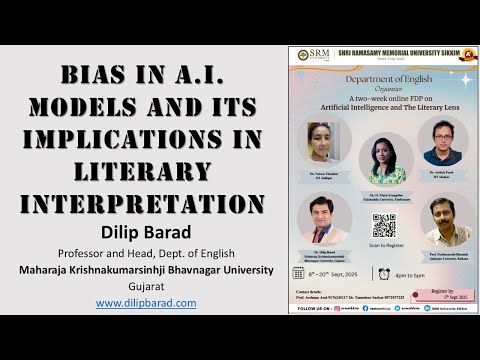
AI Bias and Literary Theory: How Algorithms Replicate Old Stereotypes

AI Bias and Literary Theory: How Algorithms Replicate Old Stereotypes I am writing this blog as an academic task assigned by Prof. Dr. Dilip...