Thursday, July 16, 2026

Mercy (2026) Review: Screenlife Cinema, AI Justice, and Surveillance Capitalism Explained

Mercy (2026) Review: Screenlife Cinema, AI Justice, and Surveillance Capitalism Explained 

This blog is written as part of a postgraduate assignment assigned by Prof. Dr. Dilip P. Barad, Department of English, MKBU. Based on the screening of Mercy (2026) and the analytical worksheet provided by him, this blog critically explores the film through the lens of Screenlife cinema and contemporary film theories. It also briefly compares Mercy with other notable Screenlife films to understand the evolution of this unique cinematic form.

Introduction

Cinema has always evolved alongside technological advancements, and Screenlife cinema is one of the most innovative developments in contemporary filmmaking. Unlike conventional films that rely on traditional camera shots and editing, Screenlife films tell their stories entirely through digital screens, including laptops, smartphones, video calls, social media platforms, and surveillance cameras. This unique storytelling style reflects the digital world in which we communicate, work, and live.

Mercy (2026), directed by Timur Bekmambetov, takes the Screenlife format into the science fiction and legal thriller genres by presenting a future where an AI judge determines a person's fate using data collected from an extensive digital surveillance network. Beyond its gripping narrative, the film raises important questions about privacy, artificial intelligence, digital evidence, and the growing influence of surveillance technologies. This blog critically examines Mercy through the lens of Screenlife aesthetics, film theory, and surveillance studies, while also comparing it with influential Screenlife films such as Unfriended, Unfriended: Dark Web, Searching, Missing, and CTRL to understand the evolution of this distinctive cinematic form.

The Ruptured Meta-Suture and Screenlife Dogma

Understanding Meta-Suture in Screenlife Cinema

Traditional cinema creates immersion through the concept of suture, where editing techniques such as the shot-reverse-shot make the camera appear invisible and seamlessly draw the audience into the story. Screenlife cinema replaces this with meta-suture, in which viewers become immersed through familiar digital actions like cursor movements, typing, buffering, notifications, and video calls. Since these interactions are part of our daily digital lives, the audience naturally experiences the narrative as if they are looking at a real computer screen rather than watching a conventional film.

Bekmambetov's Screenlife Rules

Director Timur Bekmambetov established a set of foundational principles for Screenlife filmmaking. The story should remain confined to a single digital screen, and the events should appear to unfold in real time. These rules create authenticity and encourage the audience to believe they are witnessing actual events through a digital device instead of a traditionally filmed movie.

How Mercy Breaks the Screenlife Format

Unlike earlier Screenlife films, Mercy frequently moves beyond its own digital interface. The film incorporates IMAX-style action sequences, drone flyovers of Los Angeles, and detailed 3D spatial reconstructions. While these scenes enhance the visual scale and cinematic spectacle, they depart from the minimalist style that defines the Screenlife genre.

Does This Strengthen or Weaken the Meta-Suture?

These transitions disrupt the film's meta-suture because they remind viewers that they are watching a carefully produced Hollywood blockbuster rather than experiencing events directly through a digital screen. The immersive illusion created by cursor movements, desktop windows, and video calls is interrupted whenever the narrative shifts into conventional cinematic imagery. As a result, the audience becomes more aware of the filmmaking process, reducing the sense of digital realism.

A Comparison with Earlier Screenlife Films

Films such as Unfriended (2014), Searching (2018), and Missing (2023) remain committed to the limitations of the Screenlife format. They generate suspense and emotional engagement using only desktop interfaces, social media, webcams, and messaging applications. Their strict adherence to the format strengthens the audience's immersion and preserves the illusion that the events are unfolding in real time.

Critical Evaluation

Mercy attempts to expand the possibilities of Screenlife cinema by combining digital interfaces with large-scale Hollywood action. Although this innovation broadens the genre's visual language, it also weakens one of its defining strengths—the immersive digital reality created through meta-suture. Therefore, the film only partially succeeds in evolving the Screenlife genre, as its frequent departures from the digital interface create moments of formal instability that distance the spectator from the unique realism that earlier Screenlife films achieved.

Remediation and the Archive Effect

Understanding Remediation and the Archive Effect

Jay David Bolter and Richard Grusin explain that digital media constantly moves between immediacy and hypermediacy. Immediacy attempts to make the medium invisible so that viewers feel completely immersed in the experience, while hypermediacy constantly reminds audiences that they are interacting with multiple digital interfaces, windows, applications, and media forms. Alongside this idea, Jamie Baron's concept of the archive effect explains how audiences perceive found footage, surveillance recordings, or digital files as authentic evidence from the past rather than as fictional creations.

Digital Evidence in Mercy

In Mercy, digital evidence becomes the foundation of the investigation. Ring camera recordings, doorbell logs, security footage, cloud archives, GPS records, and municipal surveillance data are used to reconstruct events and determine the protagonist's innocence. These digital traces create the impression that viewers are examining genuine evidence collected from a network of connected devices. The film therefore attempts to generate the archive effect by presenting these materials as authentic digital records.

Hypermediacy and the Loss of Authenticity

Although Mercy relies heavily on archival-style footage, its polished visual design reduces the authenticity of these digital fragments. The multi-window desktop interface, smooth transitions, cinematic animations, and perfectly organised digital layouts constantly draw attention to the technology itself. Instead of feeling like accidental or unedited recordings discovered during an investigation, the files appear carefully designed for a blockbuster film. This emphasis on visual perfection creates hypermediacy, where viewers become more aware of the interface than the evidence it contains.

Ring Cameras: Evidence or Product Placement?

A particularly interesting aspect of the film is its extensive use of Amazon Ring cameras and smart home devices. Since Mercy is produced by Amazon MGM Studios, the repeated appearance of Ring technology can be interpreted in two ways. On one hand, these devices function as important narrative tools that help reconstruct the crime and advance the investigation. On the other hand, their constant visibility risks making them appear as commercial products rather than neutral pieces of evidence. Instead of questioning the reliability of surveillance technology, the film often presents these devices as efficient, trustworthy, and indispensable.

Critical Evaluation

Unlike earlier Screenlife films such as Searching and Missing, where digital files feel spontaneous and closely resemble everyday computer use, Mercy presents an interface that is highly stylised and visually polished. As a result, the archive effect becomes weaker because the digital evidence loses some of its documentary authenticity. While the film successfully demonstrates how digital archives can shape legal investigations, its blockbuster aesthetics and prominent display of branded surveillance technology reduce authentic-looking digital debris to something that occasionally resembles commercial product placement. Consequently, Mercy reflects the tension between creating an immersive digital archive and promoting the technological ecosystem on which its fictional world depends.


Apparatus Theory and the Reciprocal Gaze

Understanding Apparatus Theory

Christian Metz's apparatus theory suggests that cinema positions the spectator as an invisible observer who watches the fictional world without being noticed. The audience occupies the role of a silent voyeur, looking into the private lives of characters while remaining outside the narrative. This traditional relationship creates a clear distance between the viewer and the events unfolding on screen.

The Reciprocal Gaze in Screenlife Cinema

Screenlife cinema transforms this relationship through webcams, video calls, and online meetings. Instead of looking past the audience, characters frequently speak directly into their device's camera. As viewers watch these conversations unfold, it often feels as though the characters are making eye contact with them. This creates what can be described as a reciprocal gaze, where the act of watching is symbolically returned. The spectator is no longer a hidden observer but feels present within the digital communication itself.

How Mercy Changes the Role of the Spectator

In Mercy, this reciprocal gaze becomes especially significant because almost every interaction occurs through surveillance systems, security cameras, and video conferencing platforms. During investigations, courtroom proceedings, and personal conversations, characters repeatedly face the camera while presenting evidence, defending themselves, or responding to the AI judge, Maddox. These moments create the impression that viewers are not merely watching the proceedings but are virtually present within the digital courtroom.

From Observer to Participant

This direct engagement breaks the traditional voyeuristic distance described by Metz. Instead of passively observing events, the audience is encouraged to analyse digital evidence, follow multiple screens, interpret surveillance footage, and piece together the truth alongside the protagonist. The viewer becomes an active participant in the investigative process, almost functioning as another observer inside the Mercy Court's vast surveillance network. The film's desktop interface further reinforces this experience by requiring viewers to constantly shift their attention between notifications, security feeds, maps, and video calls.

Critical Evaluation

By placing the audience within an environment of constant digital observation, Mercy blurs the boundary between spectator and participant. The reciprocal gaze transforms viewers into symbolic members of the surveillance system itself, making them complicit in the collection and interpretation of personal data. Rather than simply watching a story unfold, the audience experiences the ethical discomfort of participating in a world where every digital action can be monitored, recorded, and judged. In this way, Mercy effectively challenges the assumptions of traditional apparatus theory and demonstrates how Screenlife cinema redefines spectatorship in the age of artificial intelligence and digital surveillance.

The Ideological Subtext of Surveillance Capitalism


AI Justice and the Politics of Surveillance

Set in Los Angeles in 2029, Mercy imagines a future where the AI judge, Maddox, determines a person's guilt by analysing data collected from a vast municipal cloud of connected devices. Every Ring camera, security feed, smartphone, vehicle, and digital record becomes part of a surveillance network that can decide whether a person lives or dies. Although the film presents this system as a warning about the dangers of artificial intelligence and automated justice, it also depends on the same surveillance infrastructure to prove the protagonist's innocence. This creates a significant ideological contradiction at the heart of the narrative.

Surveillance Capitalism in Mercy

The concept of surveillance capitalism, introduced by Shoshana Zuboff, describes how corporations collect, analyse, and profit from personal data. In Mercy, surveillance technology is not only controlled by the state but is also closely associated with corporate digital ecosystems. Since the film is produced by Amazon MGM Studios and prominently features Amazon Ring cameras, the repeated use of these devices raises important questions. Instead of critically examining the expansion of corporate surveillance, the film often presents these technologies as reliable tools that ultimately help uncover the truth. As a result, the distinction between storytelling and product promotion becomes increasingly blurred.

Foucault's Panopticon and the Digital Society

Michel Foucault's concept of the panopticon explains how people modify their behaviour when they believe they are constantly being watched. In Mercy, the municipal cloud functions as a modern digital panopticon. Citizens live in a world where every movement, conversation, and digital interaction can be recorded, stored, and analysed by an AI-powered judicial system. Surveillance is no longer limited to prisons or police investigations; it becomes an invisible and continuous presence throughout everyday life. The film illustrates how power operates through constant observation rather than physical force.

Does the Film Challenge or Reinforce the System?

Although Mercy appears to criticise authoritarian surveillance and AI-driven justice, its ending offers a more ambiguous message. The protagonist survives because the surveillance network successfully uncovers evidence proving his innocence, yet the larger Mercy Capital Court system remains intact. Rather than dismantling or fundamentally questioning the surveillance infrastructure, the narrative suggests that the system merely requires better use or more accurate data. This implies that the problem lies with imperfect implementation rather than with mass surveillance itself.

Critical Evaluation

From an ideological perspective, Mercy only partially succeeds as a critique of surveillance society. While it exposes the dangers of artificial intelligence making life-and-death decisions, it simultaneously legitimises the very technologies it claims to question. By portraying Amazon Ring cameras and interconnected surveillance devices as essential instruments of justice, the film risks normalising corporate data collection and the erosion of personal privacy. Viewed through Foucault's concept of the panopticon, Mercy ultimately reflects a society where continuous surveillance is accepted as a necessary condition for security and justice. Consequently, the film functions both as a cautionary tale and as a subtle endorsement of the digital surveillance systems on which its own narrative depends.

Conclusion

Mercy (2026) demonstrates that Screenlife cinema has evolved far beyond being a cinematic experiment. It has become a powerful storytelling form capable of exploring contemporary concerns such as artificial intelligence, digital surveillance, online identity, and algorithmic justice. Through the concepts of meta-suture, remediation, the archive effect, apparatus theory, and the panopticon, the film reveals how our everyday digital interactions have become central to both cinematic storytelling and modern life.

At the same time, Mercy exposes the contradictions of the digital age. While it warns against the dangers of AI-driven justice and mass surveillance, it also relies on the very surveillance technologies it seeks to question. This ideological tension makes the film an important subject for critical discussion rather than a straightforward cautionary tale. Compared with earlier Screenlife films such as Unfriended, Searching, Missing, and CTRL, Mercy expands the visual possibilities of the genre but also challenges its defining principles by blending Screenlife aesthetics with conventional blockbuster filmmaking.

Ultimately, Mercy reminds us that in today's world, every click, message, camera feed, and digital footprint can become part of a larger system of observation. As Screenlife cinema continues to evolve, it not only changes the way stories are told but also encourages audiences to reflect on the relationship between technology, privacy, power, and the future of human freedom.

Works Cited

Baron, Jamie. The Archive Effect: Found Footage and the Audiovisual Experience of History. Routledge, 2014.

Bekmambetov, Timur, director. Mercy. Performances by Chris Pratt, Rebecca Ferguson, and Kali Reis, Amazon MGM Studios and Bazelevs, 2026.

Bekmambetov, Timur, director. Unfriended. Performances by Shelley Hennig, Moses Storm, Renee Olstead, and Will Peltz, Universal Pictures, 2014.

Bolter, Jay David, and Richard Grusin. Remediation: Understanding New Media. MIT Press, 1999.

Barad, Dilip P. Film Studies – Screenlife Cinema – Mercy (2026). ResearchGate, 2026, https://www.researchgate.net/publication/410049724_Film_studies_-_Screenlife_Cinema_-_Mercy_2026. Accessed 16 July 2026.

Foucault, Michel. Discipline and Punish: The Birth of the Prison. Translated by Alan Sheridan, Vintage Books, 1995.

Johnson, Aneesh, and Will Merrick, directors. Missing. Performances by Storm Reid, Joaquim de Almeida, and Nia Long, Sony Pictures Releasing, 2023.

Metz, Christian. The Imaginary Signifier: Psychoanalysis and the Cinema. Translated by Celia Britton et al., Indiana University Press, 1982.

Miller, Toby. "Screen Life." A Companion to Critical and Cultural Theory, edited by Imre Szeman, Sarah Blacker, and Justin Sully, Wiley Blackwell, 2017, pp. 365–379.

Nicholas D. Johnson and Will Merrick, directors. Searching. Performances by John Cho, Debra Messing, Michelle La, and Joseph Lee, Sony Pictures Releasing, 2018.

Sengupta, Vikramaditya Motwane, director. CTRL. Performances by Ananya Panday and Vihaan Samat, Netflix, 2024.

Stephen Susco, director. Unfriended: Dark Web. Performances by Colin Woodell, Stephanie Nogueras, Betty Gabriel, and Rebecca Rittenhouse, Universal Pictures, 2018.

Zuboff, Shoshana. The Age of Surveillance Capitalism: The Fight for a Human Future at the New Frontier of Power. PublicAffairs, 2019.

Understanding One-Shot Cinema: A Case Study of Adolescence

Understanding One-Shot Cinema: A Case Study of Adolescence

This blog is written as part of a Film Studies assignment given by Prof. Dr. Dilip P. Barad, Department of English, MKBU. For this task, Sir asked us to explore the concept of one-shot filmmaking by studying the Wikipedia page on One-shot film and a detailed study material on the Netflix series Adolescence. Based on these resources and our classroom discussion, this blog presents my understanding of what one-shot cinema is and how it enhances storytelling through a continuous, immersive visual experience.

Introduction

Cinema has always been a powerful medium of storytelling, constantly evolving through new techniques that enhance the audience's experience. Among these techniques, one shot filmmaking stands out for its ability to present a story in one continuous take without visible cuts. Unlike conventional films that rely on frequent editing, a one shot film creates the feeling of witnessing events as they naturally unfold in real time. This uninterrupted flow strengthens realism, builds emotional intensity, and draws viewers deeper into the narrative. In recent years, several filmmakers have embraced this challenging style not merely to showcase technical excellence but to enrich storytelling itself. Through this blog, I explore the concept of one shot filmmaking, its artistic significance, and how the Netflix series Adolescence demonstrates the true potential of this unique cinematic approach.

What is a One Shot Film?


A one shot film, also known as a one take or continuous shot film, is a film or television episode that is captured in a single uninterrupted take or is carefully designed to appear as though it has been filmed without any visible cuts. Unlike traditional filmmaking, where multiple shots are edited together to create a seamless story, a one shot film maintains a continuous visual flow from beginning to end. This technique allows the audience to experience the events in real time, creating a stronger sense of presence and emotional involvement.

The idea of one shot filmmaking is not simply about avoiding edits. It is about making the camera an active participant in the story. As it follows the characters without interruption, the audience feels as though they are moving alongside them and witnessing every moment as it happens. This continuous perspective often creates greater tension, realism, and intimacy because there are no breaks to distract viewers or shift their attention.

Although one shot filmmaking appears effortless on screen, it is one of the most demanding techniques in cinema. Every movement of the actors, camera operators, lighting crew, sound team, and background performers must be perfectly coordinated. Even a small mistake can require the entire scene to be performed again. For this reason, one shot films demand extensive rehearsals, careful choreography, and exceptional teamwork.

Many renowned filmmakers have used this technique to create memorable cinematic experiences. Films such as Rope, Russian Ark, Victoria, Boiling Point, and the recent Netflix series Adolescence demonstrate how the one shot format can become an important storytelling tool rather than merely a technical achievement. When used effectively, it strengthens the emotional connection between the audience and the narrative, making the experience more immersive and unforgettable.

History and Evolution of One Shot Filmmaking

Although one shot filmmaking has become increasingly popular in recent years, the technique has existed for several decades. One of the earliest filmmakers to experiment with this style was Alfred Hitchcock, whose film Rope (1948) was designed to appear as one continuous take. Due to the technical limitations of film reels at the time, hidden cuts were carefully placed to maintain the illusion of continuity. Since then, advancements in digital filmmaking have made it possible for directors to create even longer uninterrupted sequences with greater precision.

Over the years, many filmmakers have explored the artistic possibilities of the one shot format. Films such as Russian Ark (2002), which was filmed in a genuine continuous take, Victoria (2015), Boiling Point (2021), and the Indian films Iravin Nizhal (2022) and Agadam (2014) have demonstrated how this technique can enhance storytelling rather than simply showcase technical excellence. Some acclaimed films, including Birdman (2014) and 1917 (2019), were carefully edited to create the convincing illusion of a single continuous shot, proving that the emotional impact of the technique can be achieved through both actual and simulated one shot filmmaking.

Today, one shot cinema is recognised as one of the most challenging and innovative forms of filmmaking. Rather than using the technique merely to impress audiences, contemporary filmmakers employ it to create realism, sustain dramatic tension, strengthen emotional engagement, and immerse viewers in the unfolding narrative. As technology continues to evolve, one shot filmmaking remains a powerful example of how cinematic form can become an essential part of storytelling itself.

Case Studies of One Shot Filmmaking


Case Study 1: Adolescence (2025)

The Netflix limited series Adolescence, directed by Philip Barantini, is one of the most remarkable contemporary examples of one shot filmmaking. Each of its four episodes is presented in a single continuous take, allowing the audience to experience every moment without interruption. Rather than using the technique merely as a visual achievement, the creators employ it to deepen the emotional impact of the narrative.

One of the series' most distinctive features is that it immediately reveals Jamie's arrest, shifting the audience's attention away from discovering the criminal and towards understanding the reasons behind his actions. The uninterrupted camera movement keeps viewers emotionally connected to every conversation, silence, and reaction, making it impossible to distance themselves from the unfolding events. As a result, the series encourages empathy instead of judgement and invites viewers to reflect on the complex social and emotional factors that influence young lives.

The production itself was equally extraordinary. Each episode required weeks of rehearsals involving actors, camera operators, technicians, and hundreds of supporting performers. Since there were no opportunities to hide mistakes through editing, every movement had to be perfectly coordinated. Adolescence demonstrates that one shot filmmaking is not simply a technical experiment but a storytelling method capable of creating realism, emotional intensity, and meaningful audience engagement.

Case Study 2: 1917 (2019)

Directed by Sam Mendes, 1917 is another celebrated example of one shot filmmaking. Although the film is not actually recorded in a single continuous take, it is carefully edited to create the convincing illusion of one uninterrupted journey. The story follows two British soldiers during the First World War as they race against time to deliver a crucial message that could save hundreds of lives.

The continuous visual style places the audience alongside the soldiers throughout their dangerous mission. Instead of observing the war from a distance, viewers experience every obstacle, moment of fear, and emotional challenge almost in real time. The absence of noticeable cuts creates constant suspense and reinforces the urgency of the narrative. In 1917, the one shot illusion is not merely a technical achievement but an essential storytelling device that immerses the audience in the harsh realities of war and makes the journey feel immediate and deeply personal.

Both Adolescence and 1917 demonstrate that one shot filmmaking is most effective when it serves the story rather than simply displaying technical brilliance. While Adolescence explores emotional and psychological realities through uninterrupted observation, 1917 uses the same cinematic approach to create tension, urgency, and a powerful sense of immersion during wartime.

Why One Shot Filmmaking Matters

One shot filmmaking is much more than a technical achievement. It is a creative storytelling technique that changes the way audiences experience a film. Since there are no visible cuts, viewers remain connected to the characters and their surroundings throughout the narrative. This continuous flow creates a strong sense of realism, making every conversation, movement, and emotion feel immediate and authentic. The audience is not simply watching events unfold but feels as though they are experiencing them alongside the characters.

Another important aspect of one shot filmmaking is its ability to sustain tension and emotional intensity. In conventional films, editing often provides brief moments of relief by shifting between scenes or perspectives. A one shot film removes these interruptions, allowing suspense, anxiety, and emotion to build naturally. This uninterrupted experience encourages viewers to become more emotionally invested in the story and its characters.

From a filmmaking perspective, the one shot technique also reflects exceptional teamwork and artistic precision. Actors must deliver consistent performances, camera operators must execute complex movements with accuracy, and every member of the production team must work in perfect coordination. The success of a one shot film depends not only on technology but also on careful planning, discipline, and collaboration.

The case studies of Adolescence and 1917 clearly demonstrate that the one shot technique is most effective when it serves the narrative rather than functioning as a visual spectacle. While Adolescence uses continuous shots to explore the emotional and psychological realities of adolescence, 1917 employs the same technique to immerse viewers in the urgency and danger of war. Together, these works illustrate that one shot filmmaking has the power to strengthen storytelling, deepen emotional engagement, and transform the audience's cinematic experience.

Conclusion

One shot filmmaking is far more than an impressive cinematic technique. It is a unique approach to storytelling that allows audiences to experience a narrative with greater realism, emotional depth, and continuity. By eliminating visible cuts, filmmakers create an immersive environment where every movement, expression, and moment unfolds naturally before the viewer. Through the case studies of Adolescence and 1917, it becomes evident that the true strength of one shot filmmaking lies not in its technical complexity but in its ability to enhance the story being told. While Adolescence uses the continuous take to explore the emotional and psychological realities of adolescence, 1917 employs the same technique to convey the urgency and intensity of war. Studying these works has deepened my understanding of how cinematic form can shape meaning and audience experience. Ultimately, one shot filmmaking demonstrates that when technique and storytelling work together, cinema becomes more than entertainment. It becomes an experience that stays with the audience long after the screen fades to black.


Works Cited

Adolescence. Created by Jack Thorne and Stephen Graham, directed by Philip Barantini, performances by Stephen Graham, Owen Cooper, Erin Doherty, Ashley Walters, and others, Netflix, 13 Mar. 2025.

Barad, Dilip. Adolescence and the Power of the One-Shot Format. Bhavnagar University, July 2025, ResearchGate, doi:10.13140/RG.2.2.34040.15360.

1917. Directed by Sam Mendes, performances by George MacKay, Dean-Charles Chapman, Mark Strong, Andrew Scott, Richard Madden, Colin Firth, and Benedict Cumberbatch, Universal Pictures and DreamWorks Pictures, 2019.

"One-shot Film." Wikipedia, The Free Encyclopedia, Wikimedia Foundation, https://en.wikipedia.org/wiki/One-shot_film. Accessed 16 July 2026.

"The Making Of Adolescence: The One-Shot Explained | Netflix." YouTube, uploaded by Still Watching Netflix, 18 Mar. 2025, https://www.youtube.com/watch?v=HG9XUSnK9g8.

Sunday, July 12, 2026

Echoes of Identity, Rebellion, and Paradox in Contemporary Indian English Poetry

Echoes of Identity, Rebellion, and Paradox in Contemporary Indian English Poetry 

A comprehensive research blog assignment for Ms. Prakruti Bhatt on post-independence Indian English poets. 


Introduction 

Literature operates as a powerful looking glass, reflecting a society's deep-seated contradictions, its systemic oppressions, its search for a fractured identity, and its ultimate existential absurdities. The landscape of postcolonial and contemporary Indian English poetry is not merely an aesthetic endeavor; it is a vibrant, chaotic, and fiercely contested mosaic of voices. These writers do not simply observe; they actively dissect the human condition through a variety of sophisticated critical lenses—ranging from continental philosophy and psychoanalysis to raw, confessional outbursts and biting social satire.  To fully appreciate the nuanced landscape of post-independence verse, one must move past a surface-level reading. We must instead structure our analysis around the complex intersection of linguistic legacy, socio-political friction, and philosophical undercurrents that shape these works. A poet writing in a postcolonial nation carries the dual burden of utilizing a historically imposed language while trying to articulate an authentic, localized experience. This tension creates a unique literary space where myth is subverted, trauma is laid bare, language is bent out of shape, and reality is viewed through the sharp lens of paradox.  This extensive post offers a systematic, academic breakdown of several pivotal poetic works and critical frameworks. We will delve deeply into French philosopher Henri Bergson’s intricate theory of laughter to decode the grim historical irony embedded within Pravin Gadhvi’s Laughing Buddha. We will examine Meena Kandasamy’s visceral, revolutionary reclamation of the classical Ekalavya myth as a site of militant Dalit resistance against academic hegemony. Furthermore, we will trace Kamala Das’s groundbreaking use of the confessional mode to shatter patriarchal enclosures in An Introduction. Moving into the realm of cultural identity, we will evaluate the postcolonial absurdity, linguistic hybridity, and fractured consciousness in Nissim Ezekiel’s satirical masterpiece, The Patriot. Finally, we will navigate the complex, emotionally charged architecture of displacement and diasporic longing through Cleanth Brooks’s critical framework of paradox in Rachna Joshi’s Leaving India. 


1. The Anatomy of Laughter: Henri Bergson and Pravin Gadhvi’s "Laughing Buddha" 

To grasp the profound sorrow, structural irony, and bleak historical commentary at the core of Pravin Gadhvi’s poem Laughing Buddha, one must first dismantle the psychological and sociological mechanics of laughter itself. Laughter is often casually understood as a spontaneous expression of joy, amusement, or lightheartedness. However, in his seminal 1900 treatise, Laughter: An Essay on the Meaning of the Comic, the French philosopher Henri Bergson completely deconstructs this assumption, presenting laughter as a rigid social corrective that operates on cold, intellectual calculation rather than genuine emotional warmth.


Bergson’s Core Drivers of Laughter 

Bergson’s philosophy isolates several crucial factors that must align for the comic spirit to manifest. Analyzing these parameters reveals a fascinating, systematic view of human behavior:


Theoretical Factor 

Detailed Conceptual 

Mechanism

Societal Implication

The Exclusively Human Element

Bergson asserts that the comic does not exist 

outside the boundaries of what is strictly human. A natural landscape, a sunset, or a mountain range may be described as beautiful, 

majestic, sublime, or ugly, but it will never be 

inherently laughable. When we laugh at an animal, a drawing, or an inanimate object, it is solely because we have detected a human attitude, a familiar human expression, or a distinctly human design mapped 

onto it.

Humanity is both the 

subject and the sole 

generator of the comic; we are fundamentally looking into a mirror of our own making.

Anesthesia of the Heart 

Laughter demands a 

temporary, absolute 

suspension of empathy. Emotion, pity, and sympathy are the greatest foes of the comic spirit. To laugh at a situation, an  individual must step aside, silence their affections, and look upon life purely as a disinterested spectator. The moment we feel compassion for a person who trips or suffers a  misfortune, the comedy vanishes, replaced by a sense of tragedy or 

concern.

Laughter appeals to the cold, pure intelligence of the mind, completely 

bypassing the emotional warmth of the heart.


The Social Echo and 

Group Complicity

Laughter is never an 

isolated, solitary 

phenomenon; it functions as a social mechanism that requires an echo within a group. Bergson defines this shared laughter as a form of "secret freemasonry" or a subconscious complicity with other laughers. It is an organized social gesture designed to read,  reprimand, and correct  specific eccentricities or deviations within the community.

We use collective laughter as a tool of social pressure, pushing rogue individuals back toward an acceptable norm of behavior.

Mechanical Inelasticity 

This is Bergson’s primary catalyst for the comic.  Society demands of its  living members a constant, alert, and elastic  adaptability of both mind and body. When a human being acts rigidly, like an automated machine, 

continuing in a straight line out of pure habit when circumstances demand a flexible adaptation, they become comic. The comic is essentially defined as 

"something mechanical encrusted upon the living."

Automated, unthinking 

habits in a dynamic world reduce a human to a machine, making them an object of ridicule.


Deciphering the Grim Irony in Gadhvi’s "Laughing Buddha" 


When we transport Bergson’s highly structured Western theory into the landscape of post-independence Indian political poetry, Pravin Gadhvi performs a brilliant act of literary subversion. He takes Bergson’s rules of laughter and twists them into a dark, historical nightmare. The entire framework of Laughing Buddha is anchored to a specific, paradigm-shifting historical event: May 18, 1974. On this day, under the leadership of Prime Minister Indira Gandhi, India conducted its very first successful underground nuclear test in the deserts of Pokhran, Rajasthan. In an act of profound geopolitical theater, the state apparatus code-named this military operation "Smiling Buddha" (or "Operation Happy Krishna" in some internal files), capitalizing on the fact that the detonation fell precisely on the auspicious day of Buddha Jayanti—the birth, enlightenment, and passing of Gautama Buddha. Gadhvi addresses this grotesque historical event with stark, cutting brevity: 

"There was an / Underground atomic blast on / Buddha's birthday-a day of / Full Moon / Buddha laughed!" 


The State's Mechanical Inelasticity 

By applying Bergson’s theoretical framework, we can instantly identify the extreme "mechanical inelasticity" residing within the actions of the state. The Indian political and scientific machinery operated with a cold, unyielding, machine-like rigidity. It pursued nuclear proliferation to assert its military dominance on the global stage, completely blinding itself to the ethical, spiritual, and pacifist legacy of the very figure whose birthday they were celebrating. The state acted as a blind machine, pushing forward in a straight line of nationalistic pride. The absolute absurdity of this scene arises from the jarring, unnatural juxtaposition of Gautama Buddha—the universal, ancient symbol of ahimsa (absolute non-violence), compassion, and spiritual enlightenment—with an underground atomic explosion capable of mass annihilation. The state's behavior is a perfect illustration of "something mechanical encrusted upon the living" spirit of Indian philosophy. 


Shattering the Rule of Emotional Anesthesia 

However, it is in the portrayal of Buddha’s response that Gadhvi completely shatters and subverts Bergson’s rules of laughter. According to Bergson, laughter cannot exist alongside emotion; it requires a cold, intellectual "anesthesia of the heart." Yet, Gadhvi writes: "There was a laughter on his / Lips and tears in his / Eyes / He was dumb that day" Buddha’s laughter completely defies the Cartesian clarity of Bergson’s theory. This is not the joyous, lighthearted laughter of amusement, nor is it the corrective, disciplining social gesture of a community enforcing compliance. Instead, it is a paralyzed, deeply tragic, and apocalyptic response to the absolute madness of human warfare. By combining laughter on the lips with tears in the eyes, Gadhvi creates an image of a shattered deity. The Buddha’s laughter is a manifestation of profound, unspeakable grief—a defense mechanism against the cognitive dissonance of a society that claims to revere spiritual enlightenment while mechanically building weapons of absolute devastation. Gadhvi forces the reader to shed their emotional anesthesia, transforming what should be a moment of nationalistic celebration into an agonizing critique of modern statecraft. 


2. Meena Kandasamy: Weaponizing Myth for Dalit Resistance 


While Pravin Gadhvi uses political irony to confront the modern state, Meena Kandasamy turns her poetic gaze toward an even older, more deeply entrenched system of violence: the structural oppression of the caste system. Writing from a fiercely radical Ambedkarite and feminist perspective, Kandasamy utilizes poetry not as a space for quiet aesthetic reflection, but as a visceral political weapon to dismantle Brahminical hegemony. To fully comprehend the revolutionary landscape of her poetry, one must first explore her non-fiction prose and interviews, where she lays the analytical foundation for her creative work.


The Modern Ekalavya and Academic Terrorism 

In a highly illuminating interview with the postcolonial scholar Ujjwal Jana, Kandasamy speaks candidly about the systemic, institutionalized casteism that continues to plague modern Indian educational institutions. She focuses her critique on the classical myth of Ekalavya from the ancient Hindu epic, the Mahabharata, identifying it as a foundational text of caste discrimination that continues to repeat itself in contemporary universities. In the traditional epic narrative, Ekalavya is a young, marginalized tribal (Nishada) boy who longs to learn the art of advanced warfare and archery. When the royal guru, Dronacharya, refuses to teach him because of his low social status, Ekalavya retreats into the forest. Demonstrating incredible resilience, self-reliance, and discipline, he builds a clay statue of Dronacharya and self-teaches himself archery to a level of perfection that surpasses even the royal prince, Arjuna. Upon discovering this, Dronacharya realizes that a lower-caste youth has outpaced the ruling class. To protect the upper-caste monopoly on power and knowledge, Dronacharya demands his guru-dakshina (the traditional teacher's fee): Ekalavya’s right thumb. Ekalavya, displaying complete obedience, severs his own thumb, effectively destroying his career as a warrior to preserve the existing hierarchy. Kandasamy completely strips away the traditional framing of this myth, which historically glorified Ekalavya’s self-sacrifice and Dronacharya’s authority. In her conversation with Jana, she maps this myth directly onto the tragic realities of contemporary education: "Ekalavya (Ekalaivan in Tamil) is the typical Dalit... he’s actually better than the best when it comes to talent and hard-work, he doesn’t have access to the best resources, his success is envied by caste-Hindu students and ‘upper’ caste teachers, who have the power to crush him." 

Kandasamy uses this comparison to define the concept of academic terrorism. She notes that modern Indian universities, far from being progressive spaces of liberation, often operate as highly hostile environments for marginalized scholars. She points to the rampant, heartbreaking phenomenon of institutional suicides among Dalit students—such as the historically significant case of Rohith Vemula—characterizing these deaths not as individual acts of despair, but as systemic institutional murders.  The educational machinery, she argues, presents the Dalit student with a brutal, unyielding binary: either do not dare to enter these sacred spaces of higher learning, or prepare to be broken until you drop out. The modern-day Ekalavyas are still forced to pay a bitter, bloody guru-dakshina to biased institutions, and today, the price extracted is no longer just a physical 

digit; it is their very lives. 


Militancy and Subversion in "Eklavyam" 

Kandasamy directly translates this sociological critique into the aesthetic space of her poem Eklavyam (alternatively titled Eklaivan). Rather than writing a passive elegy that laments Ekalavya as a tragic, helpless victim of ancient history, Kandasamy performs a radical act of mythic revisionism. She transforms the character into a symbol of militant, uncompromising resistance.  She begins by entirely re-imagining the consequences of the mutilation, offering a dark, comforting alternative that bypasses the loss of the right thumb: "This note comes as a consolation: / You can do a lot of things / With your left hand." By explicitly urging the modern Ekalavya to embrace and master the use of the left hand, Kandasamy operates on multiple symbolic layers. On a literal level, she reminds the oppressed that a singular physical loss does not mean absolute defeat. On a political level, the "left hand" serves as a direct reference to radical left-wing ideologies, Marxist frameworks, and communist subversions that seek to overthrow entrenched capitalist and feudal power structures. The left hand becomes the hand of political rebellion, a tool to bypass and outmaneuver the "fascist Dronacharyas" who govern modern society. 

The poem reaches its defiant, revolutionary peak by completely discarding the ancient expectation of non-violent, submissive Dalit behavior: 


"You don’t need your right thumb, / To pull a trigger or hurl a bomb." 


Here, Kandasamy completely rejects the path of quiet suffering. By connecting her interview assertions to the visceral language of the poem, it becomes clear that she is utilizing the Ekalavya myth not as a site of historical mourning, but as an active blueprint for contemporary Dalit empowerment.  She explicitly alerts the marginalized that they owe absolutely no loyalty to an encoded, oppressive socio-religious hierarchy that seeks their destruction. By replacing the submissive bow and arrow with the modern vocabulary of political militancy—the trigger and the bomb—Kandasamy demands a complete inversion of power, insisting that the modern Ekalavya must hit back against institutional violence to reclaim his humanity.


3. Kamala Das and the Architecture of the Confessional "I" 

While Meena Kandasamy uses political myth-making to stage a rebellion against external social structures like caste, Kamala Das turns her focus inward. She uses the raw, intimate, and often painful details of her personal life to mount a fierce rebellion against the domestic and cultural limitations imposed upon women in patriarchal India. Writing during the mid-20th century, a time when women writers were heavily pressured to maintain an image of quiet, domestic modesty, Das broke open the landscape of Indian English poetry by introducing an uncompromising, deeply vulnerable confessional voice. 


Understanding the Confessional Style of Poetry 

To understand the radical nature of Das’s poetic style, one must locate her within the broader global framework of Confessional Poetry, a literary movement that emerged in the West during the late 1950s and 1960s through the works of writers like Sylvia Plath, Anne Sexton, and Robert Lowell. 


● Unfiltered Autobiography: Confessional poetry is defined by its frank, straightforward, and entirely unfiltered expression of the poet's private life. It completely doing away with the traditional, detached poetic masks or personas favored by high modernist poets like T.S. Eliot. 


● Dismantling Taboos: It deliberately steps into areas of human experience that society labels as taboo, shameful, or unspeakable. Confessional poets write openly about themes such as sexual humiliation, psychiatric breakdowns, domestic despair, physical aging, and taboo desires, completely stripping away any sense of social guilt or moral hesitation. 


● The Power of the Intimate "I": This style relies on the heavy use of a highly personal, autobiographical first-person perspective. It invites the reader into a secret confidence, blurring the line between the historical individual who suffered and the artistic voice speaking on the page. 


Reclaiming Identity in "An Introduction" (1965) 

In her landmark 1965 poem An Introduction, published in her debut collection Summer in Calcutta, Kamala Das uses this confessional voice as a razor-sharp tool to resist patriarchal expectations and assert her absolute individuality across multiple fronts: linguistic, physical, societal, and existential. 

Resisting Linguistic and Cultural Categorization 

The poem opens by beautifully weaving the macro-politics of postcolonial nationhood with the micro-politics of the female body. Das establishes her identity through lines that read like a passport declaration, yet carry an underlying current of defiance: 


"I am Indian, very brown, born in Malabar, / I speak three languages, write in / Two, dream in one." 


She immediately confronts the policing forces of her environment—the patriarchal figures she labels as "critics, friends, visiting cousins"—who continually demand that she stop writing her poetry in English. In a post-independence India deeply anxious about cultural purity, English was often demonized as the language of the white colonizer, an unnatural choice for an Indian woman. Das uses her confessional voice to launch a powerful counter-offensive. She argues that the language she speaks is hers by right of usage, regardless of its historical origins: "The language I speak becomes mine, / Its distortions, its queernesses / All mine, mine alone. / It is half English, half Indian, funny no doubt, but it is honest, / It is as human as I am human..." By claiming absolute ownership over her chosen tongue—with all its grammatical flaws and regional inflections—Das performs her first major act of resistance. She refuses to allow her intellect to be policed by external cultural gatekeepers. 


Exposing the Trauma of Forced Maturity and Marriage 

Das then shifts her confessional gaze to the deeply painful trauma of female physical maturation and the violence of child marriage within traditional Indian society. With a clinical, unvarnished honesty that shocked her contemporary readers, she details the rapid changes of puberty and her intense psychological resistance to them: 


"...my limbs / Swelled and one or two places sprouted hair. / When I asked for love, not knowing what else to ask / For, he drew a youth of sixteen into the / Bedroom and closed the door. He did not beat me / But my sad woman-body felt so beaten. / The weight of my breasts and womb crushed me. / I shrank Pitifully." 

This passage is a masterclass in confessional subversion. By exposing the raw vulnerability of her sixteen-year-old self, Das strips away the highly romanticized, sacred myths that Indian patriarchal culture constructed around arranged marriage and domesticity. She exposes the reality of an environment where a young girl’s emotional plea for love is met with a cold, non-consensual exercise of male physical dominance. The "breasts and womb" are transformed from traditional symbols of celebrated motherhood into heavy, suffocating physical burdens that crush her sense of self. 


Resisting Gender Roles and Expectations 

To cope with this profound domestic trauma, Das attempts a radical act of gender rebellion. She tries to erase her female identity entirely, adopting a gender-fluid presentation to escape the prison of domestic expectations: 


"I wore a shirt and my / Brother's trousers, cut my hair short and ignored / My womanliness." The response from society—whom she tellingly calls "the categorizers"—is swift, aggressive, and punitive. The patriarchal collective cannot tolerate an un-categorized woman. They immediately surround her, shouting commands designed to force her back into traditional, submissive gender roles: 


"Dress in sarees, be girl / Be wife, they said. Be embroiderer, be cook, / Be a quarreller with servants. Fit in. Oh, / Belong, cried the categorizers. Don't sit / There on the walls or peep in through our lace windows. / Be Amy, or be Kamala. Or, better / Still, be Madhavikutty..." The environment demands absolute compliance, ordering her to choose a singular, safe, and socially legible identity, even providing her with a list of acceptable male-approved pseudonyms ("Amy", "Kamala", "Madhavikutty"). They explicitly warn her against defying these roles, labeling any display of authentic female passion or psychological distress as signs of "schizophrenia" or the behavior of a "nympho."


Appropriating the Universal "I" 

The ultimate act of resistance in An Introduction occurs in its magnificent, sweeping conclusion. Das steps completely out of her individual suffering to aggressively appropriate the singular pronoun "I." In a deeply patriarchal world, the pronoun "I" is a linguistic luxury traditionally reserved for men; it is the ultimate expression of historical agency, authority, and independence, while the woman is continually expected to exist as a submissive "other." Das completely shatters this binary by claiming that masculine agency for herself. She expands her personal "I" into a vast, universal force that encompasses all human dualities: "I am sinner, / I am saint. I am the beloved and the / Betrayed. I have no joys that are not yours, no / Aches which are not yours. I too call myself I."  Through this uncompromising confessional mode, Das refuses to be minimized, labeled, or tucked away into a domestic corner. She successfully builds an identity that is vast, messy, and unashamedly autonomous. 


4. Nissim Ezekiel’s "The Patriot": Postcolonial Absurdity and Linguistic Legacy 


While Kamala Das seeks liberation by looking inward at the trauma of the self, Nissim Ezekiel looks outward at the broader, collective landscape of the Indian nation. Writing as a highly educated, deeply observant member of the tiny Bene Israel Jewish community in Mumbai, Ezekiel occupied a unique position in post-independence India. He was simultaneously an insider who loved his country and an analytical outsider who could see its flaws with startling clarity. 

His brilliant poem The Patriot stands as an exceptional cultural artifact. It directly addresses what the literary critic Sharma defines as a highly layered creative exercise: "Ezekiel's poem is not only a satirical take on the fractured postcolonial identity and the linguistic legacy of British colonialism but also an expression that encapsulates the absurd optimism and unresolved contradictions of the post-independence Indian consciousness."


Justifying the Satirical Elements in "The Patriot" 

Ezekiel achieves his brilliant social commentary through a highly deliberate, stylized deployment of language, utilizing a specific dialect to expose the complex psychic state of a newly independent nation. 


Satire on the Linguistic Legacy of British Colonialism 

Ezekiel structures the entire poem as a dramatic monologue spoken by an anonymous, intensely nationalistic Indian citizen. The defining creative masterstroke of the poem is that it is written entirely in what scholars call Babu English or Indian English—a unique linguistic hybrid characterized by literal translations from native Indian languages (like Hindi or Gujarati) into English syntax. The speaker’s language is instantly recognizable through its constant, grammatically awkward use of the present continuous tense, a direct feature carried over from Indian vernacular

speech structures: 


"Why world is fighting fighting / Why all people of world / Are not following Mahatma Gandhi, / I am simply not understanding." 


The satire becomes wonderfully explicit when the speaker reveals his deep, ongoing anxiety regarding his own colonial conditioning. He openly admits to reading the premier colonial-era English newspaper, The Times of India, not necessarily for its journalistic content, but specifically "To improve my English Language."  Furthermore, the speaker desperately attempts to perform a sense of high Western intellectualism to impress his silent listener. He does this by awkwardly misquoting and dropping a classic line from Shakespeare’s Julius Caesar:  "Friends, Romans, Countrymen, I am saying (to myself) / Lend me the ears." Through these linguistic choices, Ezekiel exposes a profound cultural irony: decades after the physical departure of the British colonizers, the mind of the independent Indian remains deeply haunted by the linguistic standards of the British Empire, constantly seeking validation through the master's tongue. 


The Fractured Postcolonial Identity 

The speaker in The Patriot perfectly embodies an identity that is split across a cultural chasm. On one hand, he is fiercely, almost aggressively nationalistic, proudly loudly proclaiming that "Ancient Indian Wisdom is 100% correct" and launching into a sharp, grumpy critique of the younger generation for abandoning traditional values in favor of foreign trends: "Modern generation is next to nothing, / Going for fashion and foreign thing." Yet, the deep, underlying irony that structures the entire poem is that this very character must rely on the language of the foreign colonizer to articulate his love for ancient Indian heritage. He is trapped in a postcolonial loop, utilizing the vocabulary of the West to validate the philosophy of the East. This tension beautifully illustrates the fractured identity of an individual caught between two worlds, unable to fully return to an idealized past or fully assimilate into a modern future. 


The Tapestry of Unresolved Contradictions 

Ezekiel’s satirical lens is at its sharpest when it exposes the speaker’s complete lack of self-awareness regarding his own internal contradictions. The character repeatedly presents himself as a pure, devout champion of peace, stating with great pride, "I am standing for peace and non-violence." Yet, in the very next breath, when he mentions a dangerous incident where a violent protester (goonda) threw a heavy stone at Prime Minister Indira Gandhi, he casually brushes it aside with an alarming lack of concern: 


"All boy-scouts are knowing it. / Just unrest, student unrest..." 


His moral worldview is entirely built on these small, hypocritical shifts. He proudly offers his guest a traditional glass of lassi, grandly proclaiming it to be "Better than wine," and smugly adds with an air of moral superiority that "Wine is for the drunkards only." Furthermore, while he stands on a pedestal preaching grand, idealistic sermons about universal human brotherhood ("All men are brothers, no?"), he instantly undermines his own noble sentiments by descending into bitter geopolitical complaints and deep-seated regional

prejudices: 


He complains that "Pakistan behaving like this, / China behaving like that," before looking inward to point out the ethnic and linguistic frictions dividing India itself, noting that while "Gujaratis, Maharashtrians, Hindi Wallahs" are all technically brothers, "some are having funny habits." Ezekiel uses this character to show how easily grand nationalistic rhetoric can hide deep internal prejudices. 


The Phenomenon of Absurd Optimism 

Despite navigating this ocean of domestic chaos, ethnic divisions, economic anxieties, and global military threats, the speaker remains completely unfazed, wrapped in a blanket of what can only be described as an "absurd optimism." Instead of offering realistic, practical solutions to the multi-layered problems of his country, he glosses over every structural crack with a sweeping, almost childlike faith in a mythic future: 


"One day Ram Rajya is surely coming." 


It is crucial to recognize that Ezekiel's portrayal is not a cold, malicious mockery of the Indian character. Rather, it is an affectionate, deeply human form of satire. The speaker’s naive, looping colloquialisms, his hospitality, his contradictions, and his desperate, enduring hope for a utopian Ram Rajya (an idealized, righteous golden age) perfectly capture the innocence, the confusion, and the complex reality of a young nation trying to forge a cohesive identity out of total chaos. 


5. The Language of Paradox in Rachna Joshi’s "Leaving India" 

While Nissim Ezekiel’s speaker stands firmly on Indian soil, looking inward at the country's internal dynamics, diasporic poets look outward from a distance. They explore the intense emotional displacement, cultural fragmentation, and psychological division that occurs when an individual leaves their homeland to settle in a foreign landscape. To analyze this specific diasporic experience with critical precision, one can look to the foundational frameworks of New Criticism, specifically the theories articulated by the influential American critic Cleanth Brooks. 


Cleanth Brooks and "The Language of Paradox" 

In his seminal 1947 work of literary theory, The Well Wrought Urn, Cleanth Brooks contains an essay titled The Language of Paradox, which completely revolutionized how we evaluate poetic structures. Brooks pushes back against the common assumption that a poem should be a clear, direct, and logical communication of a thought. Instead, he posits a radical claim:


"The language of poetry is the language of paradox." 


Brooks defines a paradox as an anomalous juxtaposition of seemingly incongruous, clashing, or completely contradictory ideas that, upon a deeper, more sustained critical examination, reveals an unexpected, profound poetic truth.  He argues that the language of science is strictly denotal—it demands a rigid, one-to-one relationship between a word and its meaning, seeking absolute clarity by eliminating contradictions. Poetry, conversely, operates entirely on connotation, layering multiple shades of meaning, history, and emotion onto a single word. Therefore, internal tension, ironic reversals, and apparent contradictions are not technical flaws in a poem; they are the essential tools needed to uncover the deepest levels of human experience. 


Navigating the Psychological Landscapes in "Leaving India" 

Rachna Joshi’s deeply evocative poem Leaving India serves as a brilliant contemporary validation of Brooks’s theoretical framework. The entire poem operates as an extended study in the language of paradox and structural irony, tracking the emotional coordinates of her emigration from the crowded, chaotic reality of India to the orderly landscapes of North America. 


The Paradox of the "Clean" New World 

The poem opens by setting up a geographic contrast that immediately subverts the reader's expectations through paradoxical imagery. Joshi describes the Western landscape of North America using terms that, on a purely literal level, appear highly attractive, positive, and desirable. She paints a picture of a world that is: 


"...clean, / orderly and shining..." 


A place filled with brilliant blue autumn skies, vibrant trees turning shades of red and orange, and an environment bathed in a pure light that is "golden and white." 

However, through a careful deployment of connotation, Brooks’s theory of paradox comes alive. Joshi begins to subtly undercut these positive descriptions, infusing them with underlying notes of profound isolation, lifelessness, and emotional bankruptcy. We learn that this beautifully organized North American landscape is, in reality, so clean that it feels "sanitized / almost sterile," an artificial space where "Everything smelt of plastic and perfume." The highly praised safety, predictability, and cleanliness of the Western world are paradoxically unmasked as an empty, soulless void: 

"In North America, there were / No ruins, No myths, no ghosts. / This really seems brave new / Naked world." 

By referencing Aldous Huxley’s dystopian Brave New World, Joshi uses paradox to show that a society that has successfully eliminated all dirt, all chaos, and all historical scars has also inadvertently eliminated its own soul, leaving behind a naked, chilly landscape devoid of spiritual depth. 


The Paradox of the "Ugly" Old World 

In direct opposition to this sterile Western perfection, Joshi constructs her description of India using words that initially appear repulsive, critical, and heavily negative. She writes that the Indian landscape is: 


"...stark, ancient and ugly..." 


A place marked by deep poverty, chaotic noise, and conditions that can be profoundly "degrading." 

Yet, as the reader moves deeper into the poem, the central paradox reveals itself: these exact negative attributes—the ancient ruins, the dirt, the crowded streets, the historical decay—are revealed to be the very sources of India's immense spiritual, emotional, and cultural vitality. The country is simultaneously described as "Magnificent" and "uplifting."  While North America is exposed as a clean but hollow void, India’s physical ugliness and historical ruins provide the individual with an irreplaceable sense of existential anchoring. 


The Ultimate Poetic Insight 

Joshi resolves these clashing geographic images by delivering a profound truth that can only be reached through the mechanics of paradox: 


"In India, all meaning comes from / Sacramental link with the Past... / Five thousand years of continuous civilisation / Lie in wait like a doting grandparent." 


The core, guiding paradox of Leaving India is that the pristine, hyper-efficient New World is emotionally isolating, while the chaotic, "ugly" Old World possesses a magnificent, sacred soul that wraps around the individual like an ancestor. Joshi masterfully uses these paradoxical juxtapositions to prove a profound philosophical point: true human beauty and emotional belonging do not reside in sterile perfection; they require the presence of ruins, the weight of myths, the companionship of ghosts, and the deep, visible scars of a long, shared civilization.


Conclusion 

The vast, intricate landscape of post-independence Indian English poetry is an active intellectual battleground where deep human truths are fought for, reclaimed, and brought to light. These poets prove that verse is not a passive mirror that merely reflects an image; it is an active force capable of breaking the mirror to show the complex machinery hidden behind it. Through the philosophical lens of Henri Bergson, we have seen how the comic and the absurd are deeply tied to humanity’s mechanical rigidities—a critical insight that Pravin Gadhvi uses to expose the tragic, nuclear hypocrisy of the modern nation-state.  Meena Kandasamy and Kamala Das successfully wield their poetry as radical weapons of liberation. Kandasamy performs an act of mythic rebellion, turning an ancient narrative of Dalit subjugation into a militant manifesto for contemporary academic resistance. Das turns her lens inward, using the raw, unfiltered honesty of the confessional style to dismantle the patriarchal boxes that attempt to govern the female body, language, and independent identity. Finally, Nissim Ezekiel and Rachna Joshi demonstrate the incredible power of satire and paradox as tools to navigate the complex labyrinth of cultural identity. Ezekiel offers an affectionate yet sharp critique of the postcolonial Indian mind, exposing its linguistic hangovers and internal hypocrisies through the cadence of Babu English. Joshi utilizes the language of paradox to map the emotional displacement of the diaspora, proving that a sterile, perfect landscape can be a spiritual desert, while a chaotic, ruined homeland can offer a sacred sanctuary.  Taken together, these diverse poetic voices offer an invaluable contribution to global literature. They demonstrate that whether dealing with the trauma of caste, the constraints of gender, the confusion of politics, or the loneliness of exile, poetry remains one of the most vital, disruptive, and illuminating forces available to humanity. 


References 


  • Bergson, Henri. Laughter: An Essay on the Meaning of the Comic. Translated by Cloudesley Brereton and Fred Rothwell, Project Gutenberg, 
  • www.gutenberg.org/files/4352/4352-h/4352-h.htm. 
  • Brooks, Cleanth. "The Language of Paradox." The Well Wrought Urn: Studies in the Structure of Poetry, Reynolds, 1947. 
  • Das, Kamala. "An Introduction." Summer in Calcutta, Everest Press, 1965. ● Ezekiel, Nissim. "The Patriot." Collected Poems (1952-1988), Oxford University Press, 1989. ● Gadhvi, Pravin. "Laughing Buddha." 
  • Jana, Ujjwal. "“The struggle to annihilate caste will be victorious”: Meena Kandasamy in Conversation with Ujjwal Jana." Postcolonial Text, vol. 4, no. 4, 2008, pp. 1-7. ● Joshi, Rachna. "Leaving India." Geography of Longing, Writers Workshop, 1996. ● Kandasamy, Meena. "Eklavyam." Touch, Peacock Books, 2006. 

Sources 

1. https://typeset.io/pdf/the-struggle-to-annihilate-caste-will-be-victorious-meena-1j6esp5qtf.pdf 2. http://oscareducation.blogspot.com/2013/06/an-introduction-by-kamala-das.html


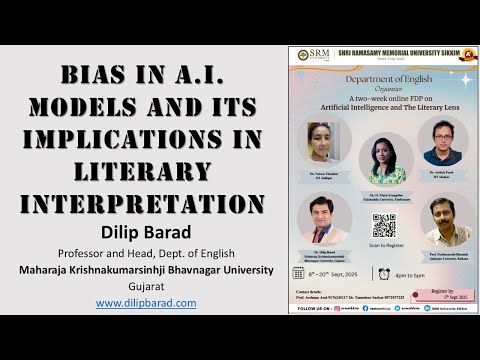
AI Bias and Literary Theory: How Algorithms Replicate Old Stereotypes

AI Bias and Literary Theory: How Algorithms Replicate Old Stereotypes I am writing this blog as an academic task assigned by Prof. Dr. Dilip...