Showing posts with label Critical Thinking. Show all posts

Sunday, December 14, 2025

Learning Beyond the Classroom: Visit to the Regional Science Centre, Bhavnagar

 Learning Beyond the Classroom: Visit to the Regional Science Centre, Bhavnagar


I am writing this blog as part of an academic activity assigned by Prof. Dilip P. Barad. The purpose of writing this blog is to reflect on our educational visit to the Regional Science Centre, Bhavnagar, conducted on 10 December. Through this blog, I aim to document my learning experience, understand the importance of experiential learning, and connect classroom knowledge with real-world observation. This blog also helps me develop reflective thinking, digital writing skills, and academic expression by sharing learning through a structured and thoughtful format. Click Here

Visit Overview


Before discussing the individual galleries in detail, it is important to mention that during our visit to the Regional Science Centre, Bhavnagar, we explored several galleries as part of a guided learning experience. These galleries included the Nobel Gallery, Electro-Mechanics Gallery, Biology Science Gallery, Automobile Gallery, and Marine & Aquatic Gallery. Each gallery offered a unique learning environment where scientific concepts were explained through interactive models, visual displays, and thoughtful guidance.

We moved through these galleries with curiosity and engagement, observing how science can be communicated not only through facts but also through stories, symbols, and real-life connections. This visit allowed us to understand science as an interdisciplinary field that connects with culture, literature, ethics, and human experience. The following sections reflect my observations and interpretations of each gallery, blending scientific understanding with literary and cultural perspectives.


Marine & Aquatic Gallery


The Marine and Aquatic Gallery was my personal favourite section of the visit because it combined scientific knowledge with a deep sense of wonder and responsibility. The displays of aquatic ecosystems revealed a hidden world of delicate balance, diversity, and quiet beauty. What made this experience more meaningful was the explanation given by our guide, who spoke genuinely about how life first emerged from water. This idea immediately transformed the gallery from a scientific space into a philosophical one.

Listening to how the earliest forms of life originated in aquatic environments made me reflect on water as the source of all existence. In literary and symbolic terms, oceans often represent origins, mystery, and the unconscious. The gallery echoed this symbolism by showing how fragile yet sustaining aquatic life is. The dependence of marine organisms on precise environmental conditions highlighted the vulnerability of ecosystems and the consequences of human interference.

Culturally and ethically, the gallery challenged human-centered thinking. It reminded us that humans are only one part of a much larger ecological story. The guide’s explanation encouraged humility and care, turning scientific observation into a moral lesson about coexistence and responsibility toward nature.


Automobile Gallery


The Automobile Gallery left a strong impression on me as it clearly showed how technological progress directly shapes human life and social structures. The evolution of vehicles presented in the gallery made me realize that automobiles are not merely machines but powerful forces that have transformed how people travel, work, and interact. They have reduced distances, accelerated daily life, and reshaped cities and economies, changing the rhythm of modern existence.


From a literary perspective, automobiles reminded me of journeys found in novels—journeys that symbolize change, freedom, and self-discovery. Just as characters move through physical spaces to reach emotional or psychological transformation, vehicles enable escape, exploration, and new possibilities. At the same time, the gallery encouraged reflection on contradictions. While automobiles promise independence and convenience, they also raise concerns about environmental damage, congestion, and unequal access.

On a cultural level, the gallery reflected modern society’s obsession with speed and progress. Life moves faster, but moments of pause and reflection become rare. This experience made me think about how technology shapes not only mobility but also human stories—fragmented, hurried, and complex. The Automobile Gallery thus presented automobiles as symbols of modern life’s paradoxes.


Biology Science Gallery


The Biology Science Gallery significantly deepened my understanding of life as a complex and interconnected system rather than a set of isolated biological processes. The exhibits explaining cell structures, human anatomy, and biological functions revealed how every form of life operates through careful balance, adaptation, and continuous change. Observing detailed models of the human body made me aware of the delicate coordination required to sustain life, highlighting both the fragility and resilience of living systems.

From an interpretive perspective, the gallery felt deeply philosophical. It challenged the traditional separation between body and mind by showing how emotions, memories, behavior, and even identity emerge from biological processes. This idea resonated with literary explorations of embodiment, where physical conditions shape emotional and psychological experiences. Literature often portrays the body as a site of conflict, limitation, and transformation, and the gallery reinforced this notion by presenting the body as an active agent rather than a passive container of the self.

Culturally and ethically, the gallery promoted empathy and shared humanity. Understanding that all humans share the same biological foundations dissolves artificial divisions based on race, gender, or social class. The gallery thus moved beyond scientific explanation to convey a humanistic message: life is interconnected, vulnerable, and deserving of care. It encouraged reflection on how biological knowledge can inspire ethical responsibility, compassion, and respect for all forms of life.


Electro-Mechanics Gallery


The Electro-Mechanics Gallery offered a powerful reflection on the evolving relationship between humans and machines in the modern world. The interactive exhibits demonstrating gears, circuits, levers, and mechanical motion immediately drew attention to the logic, rhythm, and precision of engineered systems. Observing machines functioning in perfect synchronization evoked strong metaphors of industrial life, where repetition and efficiency dominate everyday existence. One particular exhibit showing continuous mechanical movement reminded me of factory imagery often found in industrial-age literature, where human individuality is threatened by routine and mechanization.

From a literary and philosophical perspective, the gallery echoed concerns raised by writers such as Charles Dickens and later Modernist thinkers who questioned the cost of technological progress. While machines operate with accuracy and consistency, human beings remain emotional, unpredictable, and vulnerable. This contrast raised an important question during the visit: are machines designed to enhance human creativity, or do humans gradually become extensions of the machines they create? The physical interaction between hand and machine symbolized a delicate tension between mastery and dependence.

Culturally, the gallery illustrated how industrialization reshaped societies by accelerating time, redefining labor, and altering social relationships. Work became faster, lives more regulated, and human interactions increasingly mediated by technology. Through a literary lens, the machines in this gallery functioned as symbols of both progress and alienation. Scientific principles thus transformed into metaphors of modern existence, where efficiency often comes at the cost of emotional depth and ethical reflection.


Nobel Gallery


The Nobel Gallery focused exclusively on achievements in the field of science, presenting the lives and discoveries of scientists whose work transformed human understanding of the natural world. What stood out most was the idea that scientific genius is not a sudden breakthrough but a gradual process shaped by curiosity, experimentation, failure, and persistence. The displays highlighted how major scientific discoveries emerged from long periods of observation, trial, and error rather than instant inspiration.

As I moved through the gallery, it became clear that these scientists were not working in isolation. Their discoveries were deeply connected to the scientific challenges and social needs of their time. Whether related to medicine, physics, or chemistry, their work responded to real human problems and reshaped the way society understands life, matter, and the universe. Science here appeared as a human endeavor driven by responsibility as much as intellect.

From an interpretive and literary perspective, the gallery challenged the myth of the solitary genius. Creativity in science appeared as disciplined imagination—similar to the way a writer revises drafts before reaching clarity. The Nobel Gallery thus presented scientific discovery as a meaningful narrative of effort, doubt, and ethical responsibility. It reinforced the idea that scientific knowledge carries cultural impact and moral consequences, influencing not only progress but also the future of humanity.


Personal Reflection

The most unexpected insight from this visit was realizing how deeply science and humanities are interconnected. I entered the Regional Science Centre expecting factual learning, but what surprised me was how each scientific exhibit invited interpretation, ethical reflection, and cultural understanding. Science was not presented as cold or mechanical; instead, it appeared as a human story shaped by imagination, responsibility, and social context.

Throughout the visit, I found strong connections with literature and cultural theory. The Nobel Gallery echoed literary ideas of creativity and disciplined imagination, while the Electro-Mechanics Gallery reflected themes of industrialization, alienation, and modernity found in nineteenth- and twentieth-century literature. The Biology and Marine Galleries raised questions of embodiment, identity, ecology, and ethics—concerns central to contemporary cultural studies and eco-criticism.

These scientific exhibits broadened my critical understanding by encouraging me to read science symbolically, much like a literary text. They taught me to question not only how knowledge is produced but also why it matters. The visit opened new interdisciplinary research possibilities, such as studying scientific narratives, ecological ethics, and the cultural impact of technology.

Most importantly, the visit reshaped my perception of the science–humanities relationship. Rather than separate disciplines, they appeared as complementary ways of understanding human existence, responsibility, and the world we inhabit.

Personal Favourite Exhibit: “The Most Dangerous Animal of the World”


This exhibit was my personal favourite because of its simplicity and powerful message. At first glance, seeing a human skeleton labelled as “The Most Dangerous Animal of the World” was shocking and unsettling. Unlike other exhibits that display external threats, this one forced me to turn my gaze inward. The message was clear and uncomfortable: humans themselves are the greatest danger to life on Earth. Scientifically, the skeleton represents human anatomy, but symbolically, it stands for human actions—war, environmental destruction, pollution, and exploitation of other species.

From a humanities perspective, this exhibit felt deeply philosophical and ethical. It reminded me of literary and cultural critiques where humans are portrayed as agents of both creation and destruction. The absence of flesh on the skeleton made it universal, suggesting that this responsibility belongs to all of humanity, not any one individual. This exhibit blurred the boundary between science and moral inquiry, transforming a biological model into a cultural symbol. It made me reflect on accountability, ecological responsibility, and the urgent need for ethical consciousness in the age of scientific and technological advancement.

Special Thanks


I would like to express my sincere gratitude to Dr. Dilip P. Barad, who thoughtfully organized this educational visit to the Regional Science Centre, Bhavnagar. His efforts in planning every aspect of the visit, from coordination to academic guidance, made this experience meaningful and well-structured. We are especially thankful to him for being present with us throughout the visit, guiding and supporting us at every stage.

His initiative in connecting classroom learning with real-world educational spaces encouraged us to explore knowledge beyond textbooks. This visit not only enhanced our understanding of science and interdisciplinary learning but also reflected his commitment to innovative and experiential teaching. We are grateful for his constant encouragement, academic insight, and dedication to student learning, which made this visit both enriching and memorable.

Conclusion

The visit to the Regional Science Centre, Bhavnagar was a valuable learning experience that highlighted the importance of interdisciplinary understanding. The key takeaway from this visit was the realization that science is not isolated from culture, ethics, or human narratives; rather, it actively shapes and is shaped by them. For students of English Studies, scientific literacy is essential in developing broader critical perspectives, enabling us to engage meaningfully with themes such as technology, ecology, embodiment, and modernity found in literature.

This visit encouraged us to read scientific exhibits as texts—rich with symbols, stories, and ethical implications. It strengthened our ability to think critically beyond disciplinary boundaries. I sincerely acknowledge Dr. Dilip P. Barad for organizing and guiding this visit, and I also thank the Regional Science Centre, Bhavnagar for providing an engaging and informative learning environment that made this educational experience both enriching and memorable.


Sunday, July 13, 2025

Questioning Like Socrates: A Timeless Guide to Truth

 This blog is a reflection based on videos shared by Prof. Dr. D. P. Barad about the life and philosophy of Socrates. The aim is to share what I learned from them and how his ideas still connect to the way we think, question, and live today.

Who Was Socrates?

A classical marble bust of Socrates, showing his contemplative gaze and rugged features , a timeless reminder of the philosopher who questioned everything.

Socrates was a classical Greek philosopher, born in Athens around 470 BCE. He is often called the father of Western philosophy, not because he wrote great texts , in fact, he wrote nothing at all ,but because of the way he lived and taught. Our knowledge of Socrates comes mainly from his students, especially Plato, who wrote dialogues featuring Socrates as a central figure. After watching the videos shared in the blog by Prof. Dr . D. P. Barad, I understood that Socrates was not a teacher in the traditional sense. He didn’t give lectures or claim to have all the answers. Instead, he believed in asking questions, deep ,uncomfortable, thought provoking ones  to help people examine their beliefs and values.

 He spent most of his time in the streets and public places of Athens, talking to ordinary citizens, including craftsmen, poets, and politicians. His goal was not to embarrass them, but to help them realise how little they actually knew. He believed that wisdom begins with self-awareness , knowing that we don’t know everything. What made his life even more meaningful was that he lived his philosophy. He didn’t change his ideas to please others or escape trouble. Even when he was put on trial for corrupting the youth and disrespecting the gods, he stood firm in his beliefs. He was sentenced to death but chose not to escape, proving that for him, staying true to one’s principles was more important than life itself. In today’s world, where people often change opinions just to fit in, Socrates’ life feels deeply inspiring.

The Trial of Socrates: When Questions Became Dangerous ;

Jacques‑Louis David’s painting The Death of Socrates captures the tension of his trial and ultimate choice ,peacefully embracing death rather than abandoning his principles.

One of the most eye-opening parts of the videos shared in Dr . D. P. Barad’s blog was the account of Socrates’ trial. As someone living in a democratic country like India, I always believed that freedom of speech and thought were basic rights. But the trial of Socrates made me realise that even in the world’s earliest democracy, ancient Athens ,truth could become uncomfortable, and uncomfortable truths could be punished. Socrates was brought to trial in 399 BCE, accused of corrupting the minds of the youth and of impiety, or disrespecting the gods worshipped by the state.

At first, these charges seem vague and almost symbolic. But when you dig deeper, it becomes clear that Socrates’ real “crime” was encouraging people , especially the younger generation , to question authority, challenge tradition, and think for themselves. He didn’t lead protests or break laws. All he did was ask questions that revealed the ignorance and hypocrisy of those in power. His method made people reflect, which not everyone liked. Some felt humiliated, others insecure. In the eyes of the powerful, Socrates had become dangerous , not because he knew everything, but because he showed them how little they knew.

As a student, this made me reflect on situations in our own society , when people are silenced for asking questions, when youth are told not to challenge traditions, or when emotional narratives are used to avoid facing hard realities. Socrates’ trial is not just ancient history; it’s a mirror we still need to look into. It reminds us that even in a democracy, critical thinking can be seen as rebellion, and that the courage to question is what truly keeps freedom alive.

The Socratic Method: Learning Through Dialogue ;

One of the most important contributions of Socrates to philosophy and education is what we now call the Socratic Method. After watching the videos linked in Dr . D. P. Barad’s blog, I realised that this method is not just about asking questions, it’s about creating a space where real thinking can happen. Socrates never claimed to be a teacher in the traditional sense. Instead, he saw himself as a midwife , helping others "give birth" to their own ideas by questioning them, step by step.

The Socratic Method works through conversation, a calm, logical back-and-forth where each answer is followed by a deeper question. This helps to uncover contradictions in thought and forces the person to think beyond surface-level understanding. Unlike debates, where the goal is to win, Socratic dialogue is meant to reach deeper truths. What I found interesting is that this method doesn’t require any books, technology, or classrooms , just two people, a question, and a willingness to think openly.

In today’s world, especially in classrooms or on social media, we often focus more on giving opinions than understanding them. The Socratic Method reminds us to slow down and ask: Why do I believe this? What assumptions am I making? What if the opposite is true? Even in literature, this method can help us go beyond the plot, to explore the author’s message, the reader’s interpretation, and the historical or political context. It’s not just a technique; it’s a mindset.

I’ve started trying this approach in my own conversations, not to challenge people aggressively, but to understand their thinking better. Sometimes it surprises them, sometimes it leads to meaningful discussion. And sometimes, it even helps me realise that my own views need rethinking. In that sense, the Socratic Method isn’t just about learning from others , it’s about learning with others.

Socrates in Today’s World: Still Asking the Right Questions

Even though Socrates lived in ancient Greece, his ideas feel surprisingly modern in today’s digital world. His way of questioning everything including politics, religion, and social values, challenges us even now. In an age where emotional appeals and viral content often replace verified facts, Socratic thinking teaches us to pause and ask, “Is this really true?” We often see people accepting WhatsApp forwards or YouTube rants without question, especially during elections or social unrest. Take, for example, how people believed exaggerated or false claims during recent protests or riots, such as the communal narratives pushed during the Delhi riots or the misinformation surrounding the hijab debate. In both cases, strong emotions shaped public opinion more than facts did. Socrates believed that a citizen’s duty is not to follow the crowd but to think independently, and that feels more relevant now than ever.

Socratic thinking also plays an important role in how we engage with education and culture today. In classrooms, students often hesitate to question what is being taught, fearing they might be wrong. But Socrates taught that questioning is not disrespectful  it is a form of learning. His method reminds us that true understanding doesn’t come from memorising facts but from examining and discussing them. I could relate this to the way many people blindly follow social media influencers, historians, or even teachers, without engaging critically with their ideas. The concept of “histofluencers”  people who simplify or twist historical facts to suit their agendas  is a perfect example. Socrates would have likely asked them, “How do you know this? What proof do you have?” In a time where loud opinions are mistaken for knowledge, his calm and honest inquiry remains deeply powerful.

What strikes me most is how Socratic thinking can be used not just in politics or education, but in everyday life. In conversations with friends or even family members, I’ve found that asking the right questions often opens minds more than making strong arguments. Instead of telling someone they’re wrong, just asking them why they believe something can lead to reflection. This is especially important in a society where many people feel offended or defensive when their views are questioned. Socrates didn’t argue to win, he argued to understand. And I think that’s something we can all learn from, especially in a time where truth is often lost in noise.

Personal Reflection: What Socrates Taught Me About Thinking

Before watching these videos, I only knew Socrates as a name from history, someone important in philosophy. But now, I see him differently. His courage to ask difficult questions, to stand by his truth even in front of death, and to accept that “I know that I know nothing” has left a deep impact on me. As someone who often overthinks things and tries to make sense of people’s behaviour and beliefs, I’ve realised how valuable this kind of questioning really is. Socrates didn’t just teach us to question others, but also ourselves, and that’s something I’ve started doing more consciously. I often find myself in situations where popular opinions are treated as facts, whether it's in discussions about religion, politics, or even simple everyday topics. Being a student of literature, I’ve learned to read deeply  but Socrates made me realize that thinking deeply is just as important. Sometimes in class or on social media, I hesitate to ask a question that goes against the flow, just to avoid arguments. But now I feel that honest questions are not a sign of disrespect , they’re a sign of engagement. Whether it's discussing a controversial poem or challenging a biased news clip, I now try to approach it with a Socratic spirit, not to prove someone wrong, but to understand what lies beneath the surface.

 His calm, thoughtful resistance against blind belief made me reflect on how easily we accept things just because everyone else does. That one line “The unexamined life is not worth living”  has stayed with me. It feels like a reminder not just for philosophers, but for all of us who want to live with awareness and honesty. Socrates didn’t just teach philosophy  he lived it. And through these videos and reflections, I feel a little closer to that idea of living thoughtfully too.

Videos Worth Watching

Here are some of the videos that helped shape my understanding of Socrates. If you're interested in exploring his life, method, and philosophy more deeply, these are a great place to start.


Conclusion :

Socrates may have lived centuries ago, but his thoughts continue to challenge and inspire us even today. In a world full of distractions, quick opinions, and emotional noise, his calm, questioning voice reminds us to slow down and think for ourselves. Whether it’s a political debate, a classroom discussion, or a personal belief, asking honest questions can lead us closer to the truth. For students, especially those in literature or humanities, Socratic thinking isn’t just an academic tool it’s a way of life. It helps us stay curious, stay humble, and stay open to learning, always. In the end, maybe that’s what makes Socrates timeless, not his knowledge, but his courage to keep searching for it.

Work Citation 

“A Lesson From Socrates That Will Change The Way You Think.” YouTube, youtu.be/yH86jaBQ0F4. Accessed 13 July 2025.

“The Trial of Socrates (Plato’s Apology).” YouTube, youtu.be/5-gyTgFjuIg. Accessed 13 July 2025.

“This Tool Will Help Improve Your Critical Thinking - Erick Wilberding.” YouTube, youtu.be/vNDYUlxNIAA. Accessed 13 July 2025.

“Socrates .” YouTube, youtu.be/zo04J4l2fpk. Accessed 13 July 2025.

“Socrates .” https://blog.dilipbarad.com/2024/06/socrates.html.

 If you enjoyed reading, feel free to leave a comment, share your thoughts, and share this blog with others who might find it meaningful. Let’s keep the conversation going ,just like Socrates would have wanted.

            
                  —  Sejad  Chokiya , MA English, Department of English, MKBU, Bhavnagar
        

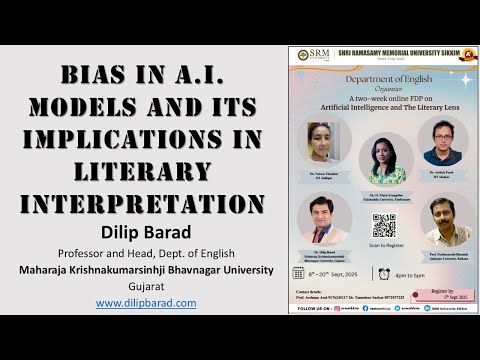
AI Bias and Literary Theory: How Algorithms Replicate Old Stereotypes

AI Bias and Literary Theory: How Algorithms Replicate Old Stereotypes I am writing this blog as an academic task assigned by Prof. Dr. Dilip...