Sunday, December 14, 2025

A Frame Study of Modern Times and The Great Dictator: Visualizing the 20th-Century Zeitgeist

 A Frame Study of Modern Times and The Great Dictator: Visualizing the 20th-Century Zeitgeist

I am writing this blog as part of an academic task assigned by Prof. Dilip P. Barad. For this activity, Sir provided a worksheet to guide our frame study of Charlie Chaplin’s Modern Times and The Great Dictator. The task aims to connect visual analysis with the socio-political setting of the early twentieth century, as discussed in A. C. Ward’s “The Setting.”

Introduction

The early twentieth century was a period of rapid industrial growth, political upheaval, and social transformation. Scientific progress promised prosperity, yet it often resulted in dehumanization, inequality, and moral decline, as observed by A. C. Ward in “The Setting” of the 20th Century. Charlie Chaplin’s films Modern Times (1936) and The Great Dictator (1940) capture these contradictions through powerful visual storytelling and satire. This blog undertakes a frame study of selected scenes from these films to explore themes such as mechanization, mass production, class disparity, propaganda, and authoritarianism. By analysing specific frames, the blog attempts to connect cinema with the socio-economic and political realities that shaped twentieth-century literature and culture.

Basic Information of the Film: Modern Times


Modern Times is a 1936 silent film written, directed, and starred by Charlie Chaplin. The film was released during the Great Depression, a period marked by widespread unemployment, economic instability, and rapid industrialization. Through the character of the Tramp, Chaplin critiques the impact of mechanized labor, mass production, and capitalist exploitation on ordinary workers. Although made in the age of sound cinema, Modern Times remains largely silent, emphasizing visual storytelling and physical comedy. The film blends humor with social criticism, exposing how industrial progress often leads to the loss of human dignity and individuality, making it a significant cultural text of the early twentieth century.


Frame Study: Title Card of Modern Times

This opening title frame of Modern Times immediately sets the ideological foundation of the film. By describing the story as one of “industry, individual enterprise, and humanity crusading in the pursuit of happiness,” Chaplin foregrounds the central conflict between mechanical progress and human values. The presence of clock-like imagery in the background subtly suggests time discipline, efficiency, and industrial control—key features of modern industrial society. While the words promise progress and happiness, the visual context hints at irony, foreshadowing how industrial systems often undermine human dignity. This frame prepares the viewer for Chaplin’s critique of a world where humanity struggles to survive within rigid, time-bound industrial structures.

Frame Study of Modern Times

The frame study of Modern Times focuses on how Charlie Chaplin uses visual images to communicate complex ideas about industrial society. Instead of relying on dialogue, Chaplin employs frames, movement, and symbols to reveal the realities of mechanization, mass production, and the loss of human individuality. Each selected frame acts as a visual text that reflects the socio-economic conditions of the early twentieth century. Through this frame study, the film can be read as a critique of modern industrial life, closely connected to the historical and cultural “setting” discussed by A. C. Ward.

Frame Study: Workers on Their Way to Work (Modern Times)

Workers Moving Toward the Factory: The Rhythm of Industrial Life

This frame captures a large group of workers walking together toward the factory in the early morning. The uniform direction of movement and the towering industrial buildings in the background emphasize how human life is organized around factory schedules and mechanical routines. Individual identities dissolve into a collective workforce governed by time, discipline, and economic necessity. The smoke and rigid architecture symbolize industrial dominance over human life. This scene reflects the early twentieth-century reality where employment dictated daily existence, echoing A. C. Ward’s observation that industrial progress often resulted in moral and human regression rather than fulfillment.

Frame Study: Power Structure inside the Factory (Modern Times)


Muscle, Money, and Mind: The Power Hierarchy of Industrial Capitalism

These frames collectively expose the hierarchical structure of industrial society in Modern Times. In the first frame, the muscular worker operates massive machinery, symbolizing muscle—physical labour reduced to mechanical strength. The second frame shifts to the factory owner seated comfortably, representing money and ownership of production. In the final frame, the boss monitors workers through screens, exercising control through mind—surveillance, planning, and authority. Chaplin visually separates labour from power, showing how workers are confined to physical exertion while decision-making remains distant and invisible. This reflects A. C. Ward’s observation that modern industrial progress intensified class divisions, where technology empowered capital while dehumanizing labour, reducing workers to monitored, controlled bodies within an impersonal system.

Frame Study: Mechanization of the Human Body (Modern Times)


Men Turned into Machines: Life on the Assembly Line


This frame shows Charlie Chaplin and other workers performing repetitive tasks on the assembly line, moving in mechanical rhythm with the conveyor belt. Human actions are reduced to automatic gestures, blurring the line between man and machine. Chaplin’s stiff posture and exaggerated movements highlight the physical and psychological strain caused by industrial labour. Individual creativity and craftsmanship disappear under the pressure of speed and efficiency. This scene reflects the early twentieth-century reality of mass production, where workers were valued only for productivity. As A. C. Ward notes, scientific advancement often resulted in moral and human regression, a condition Chaplin exposes through visual satire.

Frame Study: Technology Replacing Human Needs (Modern Times)

The Feeding Machine: Efficiency at the Cost of Humanity


In the first frame, a scientist presents an automatic feeding machine to the factory owner, claiming it will save time by allowing workers to eat without using their hands. This reflects the industrial obsession with efficiency and profit, where even basic human needs like eating are mechanized. In the second frame, Charlie Chaplin is chosen as the test subject, turning the worker into an experimental object. The machine’s failure exposes the absurdity of treating humans as machines. Chaplin satirically reveals how industrial capitalism prioritizes productivity over dignity, echoing A. C. Ward’s idea that scientific progress often leads to moral and human regression rather than genuine advancement.

Frame Study: Total Mechanization of Human Life (Modern Times)

Caught in the Gears: When Humans Become Part of the Machine


In this frame, Charlie Chaplin is literally trapped inside the moving gears of the machine while trying to escape from his fellow workers. The image powerfully symbolizes how deeply humans are absorbed into industrial systems. Chaplin’s body becomes a mechanical component, suggesting that workers are no longer separate from machines but are controlled by them. This scene visually represents human dependency on technology and the loss of autonomy under industrial capitalism. As A. C. Ward observes, the twentieth century witnessed immense technological progress accompanied by moral and human regression. Chaplin’s satire exposes how machines, created to serve humans, end up dominating and imprisoning them.

Frame Study: Labour Resistance and State Control (Modern Times)

Voices of the Workers: Protest Against Industrial Exploitation


This frame depicts Charlie Chaplin leading a group of workers in a protest against factory conditions and industrial exploitation. The placards demanding unity and freedom reflect workers’ collective resistance to injustice, unemployment, and inhuman working conditions. Chaplin’s accidental leadership highlights how ordinary individuals are often drawn into political movements during times of crisis. The police intervention represents the role of the state in suppressing labour movements and protecting industrial interests. This scene mirrors the socio-political realities of the early twentieth century, when workers’ strikes were frequently met with force. As A. C. Ward notes, industrial progress intensified class conflict, exposing the gap between economic growth and human welfare.

Frame Study: Economic Crisis and Social Neglect (Modern Times)


Unemployment and Human Indifference: The Silent Tragedy of the Poor


In the first two frames, the Gamin’s father is shown sitting in despair, burdened by unemployment and economic insecurity. His posture and facial expression reflect anxiety, helplessness, and loss of dignity caused by joblessness during the Great Depression. Chaplin presents unemployment not just as an economic condition but as a psychological crisis. In the final frame, the father collapses and dies on the street, surrounded by onlookers who show curiosity rather than compassion. This visual indifference exposes the moral decay of industrial society. As A. C. Ward observes, the twentieth century’s economic progress failed to protect basic human values, leaving the poor invisible and unsupported.

Frame Study: Class Bias and Social Hypocrisy (Modern Times)

Class Prejudice Behind Bars: Respectability and Social Hierarchy


In this frame, Charlie Chaplin sits beside the wife of the prison authority after being brought to prison despite his good behaviour. Although Charlie is harmless and well-intentioned, his appearance and class background make the woman uncomfortable. Her body language and expression reflect social prejudice and the rigid class distinctions of industrial society. Chaplin highlights how respectability is judged not by character but by social status and outward appearance. Even in institutions meant to reform, inequality persists. This scene satirically exposes the hypocrisy of a society that claims moral superiority while discriminating against the poor, echoing A. C. Ward’s observation of moral regression beneath modern progress.

Frame Study: Hope and Human Resilience (Modern Times)


Walking Toward Hope: Humanity Beyond Machines

This final frame shows Charlie Chaplin and the Gamin walking together on an open road, leaving behind the industrial city. They possess no wealth, employment, or security, yet they move forward with hope and companionship. The vast landscape contrasts sharply with the confined factory spaces seen earlier in the film, symbolizing freedom from mechanical control. Chaplin suggests that while industrial society fails to provide dignity or stability, human solidarity and optimism remain sources of survival. This ending reflects A. C. Ward’s idea that despite moral and social collapse in the twentieth century, the human spirit continues to seek meaning beyond material progress.

Open Frame for Interpretation

Before concluding this frame study, I have included a few additional frames from Modern Times without detailed analysis. These frames are intentionally left open to interpretation, inviting readers to observe, reflect, and construct their own meanings. Chaplin’s cinema is rich with visual symbolism, where even a single frame can reveal multiple layers of social, economic, and emotional significance. By engaging with these frames independently, readers can deepen their understanding of industrial society, human struggle, and resilience. This approach also reflects the idea that interpretation is not fixed but shaped by individual perspective, context, and critical awareness.


Frame Study of The Great Dictator


Basic Information of the Film: The Great Dictator

The Great Dictator is a 1940 political satire written, directed by, and starring Charlie Chaplin. It was Chaplin’s first full sound film and was released during the rise of fascism in Europe, just before the United States entered the Second World War. In the film, Chaplin plays a dual role—a Jewish barber and the dictator Adenoid Hynkel, a parody of Adolf Hitler. Through satire, comedy, and powerful rhetoric, the film critiques authoritarian leadership, propaganda, militarism, and the persecution of minorities. The Great Dictator stands as a courageous cinematic response to the political crises of the twentieth century.


The Great Dictator (1940) is Charlie Chaplin’s bold political satire on the rise of dictatorship and fascism in early twentieth-century Europe. Unlike Modern Times, this film directly addresses political power, propaganda, war, and the suppression of human rights. Through the dual roles of a Jewish barber and the dictator Adenoid Hynkel, Chaplin exposes the absurdity, cruelty, and egoism of authoritarian leaders. The film reflects the socio-political anxieties of the pre–World War II era, a period marked by nationalism, mass manipulation, and violence against minorities. This frame study analyzes selected scenes to understand how Chaplin uses imagery, performance, and satire to critique dictatorship and to reveal the dangerous consequences of unchecked power, as discussed in A. C. Ward’s understanding of the twentieth-century setting.

Frame Study: War as the Setting of the 20th Century (The Great Dictator)

A World at War: The Destruction that Precedes Dictatorship


This opening frame presents a battlefield filled with smoke, broken machinery, and destruction, immediately situating the film in the violent reality of the early twentieth century. The chaos of war reflects the devastating consequences of nationalism, militarism, and political ambition. Chaplin begins the film not with comedy but with conflict, reminding viewers that dictatorship emerges from war and instability. This scene aligns with A. C. Ward’s observation that the twentieth century was shaped by large-scale violence enabled by modern technology. The ruined landscape symbolizes how scientific and industrial progress, instead of safeguarding humanity, often intensified destruction and human suffering.

Frame Study: Technology and Mass Destruction (The Great Dictator)


The Scale of Destruction: Industrialized Warfare


This frame focuses on a massive artillery cannon, emphasizing the scale and power of modern weapons used during the World Wars. The oversized barrel dominates the landscape, suggesting how technological advancement in the twentieth century was directed toward destruction rather than human welfare. Chaplin highlights the irony of scientific progress being used to magnify violence and death. This image reflects A. C. Ward’s observation that modern civilization achieved unprecedented mastery over the physical world while simultaneously experiencing moral and spiritual collapse. The frame reminds viewers that war in the modern age is no longer individual combat but mechanized, impersonal, and devastating on a massive scale.

Frame Study: Propaganda and the Politics of Information (The Great Dictator)


Manufacturing Truth: Media, Power, and the Victors’ Narrative


This frame shows a newspaper headline announcing “Riots in Tomainia” after the war, revealing how media becomes a tool of power once conflict ends. Instead of focusing on human loss or suffering, the newspaper frames events to glorify authority and legitimize the victor’s control. Chaplin highlights how truth is shaped by those in power, turning journalism into propaganda. The repetition and bold typography emphasize how easily public opinion can be guided through print media. This reflects the early twentieth-century reality where authoritarian regimes used newspapers to manipulate perception. As A. C. Ward suggests, modern progress also produced new instruments of control, allowing power to dominate not only land but also truth itself.

Frame Study: Rhetoric, Control, and the Obedient Crowd (The Great Dictator)

Orchestrated Applause: Mass Psychology under Dictatorship


These two frames expose how authoritarian leaders manipulate the masses through spectacle and command. In the first frame, a vast, uniform crowd signifies collective submission, where individuality dissolves into mass identity. In the second frame, Adenoid Hynkel (Chaplin’s parody of Hitler) controls the audience’s response with mere gestures—one signal triggers thunderous applause; another enforces instant silence. Chaplin satirizes the mechanics of propaganda, revealing how rhetoric replaces reason and obedience substitutes for thought. This visual choreography of clapping demonstrates the loss of critical agency under fascism. As A. C. Ward notes, the twentieth century saw new techniques of mass persuasion, enabling power to dominate not just bodies, but minds.

Frame Study: Ghettoization and Threat to Human Rights (The Great Dictator)

Fear and Uncertainty: Minorities under the Shadow of Aryan Power


This frame shows two Jewish characters seated in quiet anxiety, reflecting fear and uncertainty about their safety in an increasingly hostile society. Their expressions and body language convey helplessness as they anticipate violence from the Aryan regime. Chaplin shifts from satire to seriousness, highlighting the psychological trauma experienced by minorities under authoritarian rule. The absence of action in the frame intensifies the tension, suggesting that danger is constant and unavoidable. This scene exposes how fascist ideologies create fear through exclusion and discrimination. As A. C. Ward notes, the twentieth century witnessed not only political upheaval but also the systematic erosion of basic human rights, particularly for marginalized communities.

Frame Study: State-Sanctioned Violence and Humiliation (The Great Dictator)

Power Without Accountability: Everyday Oppression in the Ghetto


Open Frames for Interpretation

Before concluding this frame study of The Great Dictator, I have included a few additional frames that I personally selected but have not analyzed in detail. These frames are intentionally left open for interpretation, allowing readers to engage with the visuals and construct their own meanings. Chaplin’s political satire is layered with symbolism, where even a single image can reveal themes of power, fear, propaganda, and resistance. By leaving these frames unexplained, the study encourages active viewing and critical thinking, reminding us that interpretation is shaped by perspective, context, and historical awareness rather than fixed conclusions.


Conclusion

This frame study of Modern Times and The Great Dictator demonstrates how Charlie Chaplin uses cinema as a powerful medium to critique the socio-economic and political realities of the twentieth century. Through visual symbolism, satire, and carefully composed frames, Chaplin exposes the dehumanizing effects of industrialization, the failure of capitalism to ensure human dignity, and the dangerous rise of authoritarian power. Modern Times reveals how machines dominate human life, while The Great Dictator uncovers how propaganda, mass psychology, and fear suppress individuality and basic rights. When read alongside A. C. Ward’s idea of the twentieth-century “setting,” these films reveal the paradox of modernity—technological progress coupled with moral regression. Ultimately, Chaplin affirms that despite oppression and suffering, humanity, empathy, and hope remain essential forces for resistance and survival.

References

Chaplin, Charlie, dir. Modern Times. United Artists, 1936.

Chaplin, Charlie, dir. The Great Dictator. United Artists, 1940.

Ward, A. C. Twentieth-Century English Literature. Methuen, 1965.

Learning Beyond the Classroom: Visit to the Regional Science Centre, Bhavnagar

 Learning Beyond the Classroom: Visit to the Regional Science Centre, Bhavnagar


I am writing this blog as part of an academic activity assigned by Prof. Dilip P. Barad. The purpose of writing this blog is to reflect on our educational visit to the Regional Science Centre, Bhavnagar, conducted on 10 December. Through this blog, I aim to document my learning experience, understand the importance of experiential learning, and connect classroom knowledge with real-world observation. This blog also helps me develop reflective thinking, digital writing skills, and academic expression by sharing learning through a structured and thoughtful format. Click Here

Visit Overview


Before discussing the individual galleries in detail, it is important to mention that during our visit to the Regional Science Centre, Bhavnagar, we explored several galleries as part of a guided learning experience. These galleries included the Nobel Gallery, Electro-Mechanics Gallery, Biology Science Gallery, Automobile Gallery, and Marine & Aquatic Gallery. Each gallery offered a unique learning environment where scientific concepts were explained through interactive models, visual displays, and thoughtful guidance.

We moved through these galleries with curiosity and engagement, observing how science can be communicated not only through facts but also through stories, symbols, and real-life connections. This visit allowed us to understand science as an interdisciplinary field that connects with culture, literature, ethics, and human experience. The following sections reflect my observations and interpretations of each gallery, blending scientific understanding with literary and cultural perspectives.


Marine & Aquatic Gallery


The Marine and Aquatic Gallery was my personal favourite section of the visit because it combined scientific knowledge with a deep sense of wonder and responsibility. The displays of aquatic ecosystems revealed a hidden world of delicate balance, diversity, and quiet beauty. What made this experience more meaningful was the explanation given by our guide, who spoke genuinely about how life first emerged from water. This idea immediately transformed the gallery from a scientific space into a philosophical one.

Listening to how the earliest forms of life originated in aquatic environments made me reflect on water as the source of all existence. In literary and symbolic terms, oceans often represent origins, mystery, and the unconscious. The gallery echoed this symbolism by showing how fragile yet sustaining aquatic life is. The dependence of marine organisms on precise environmental conditions highlighted the vulnerability of ecosystems and the consequences of human interference.

Culturally and ethically, the gallery challenged human-centered thinking. It reminded us that humans are only one part of a much larger ecological story. The guide’s explanation encouraged humility and care, turning scientific observation into a moral lesson about coexistence and responsibility toward nature.


Automobile Gallery


The Automobile Gallery left a strong impression on me as it clearly showed how technological progress directly shapes human life and social structures. The evolution of vehicles presented in the gallery made me realize that automobiles are not merely machines but powerful forces that have transformed how people travel, work, and interact. They have reduced distances, accelerated daily life, and reshaped cities and economies, changing the rhythm of modern existence.


From a literary perspective, automobiles reminded me of journeys found in novels—journeys that symbolize change, freedom, and self-discovery. Just as characters move through physical spaces to reach emotional or psychological transformation, vehicles enable escape, exploration, and new possibilities. At the same time, the gallery encouraged reflection on contradictions. While automobiles promise independence and convenience, they also raise concerns about environmental damage, congestion, and unequal access.

On a cultural level, the gallery reflected modern society’s obsession with speed and progress. Life moves faster, but moments of pause and reflection become rare. This experience made me think about how technology shapes not only mobility but also human stories—fragmented, hurried, and complex. The Automobile Gallery thus presented automobiles as symbols of modern life’s paradoxes.


Biology Science Gallery


The Biology Science Gallery significantly deepened my understanding of life as a complex and interconnected system rather than a set of isolated biological processes. The exhibits explaining cell structures, human anatomy, and biological functions revealed how every form of life operates through careful balance, adaptation, and continuous change. Observing detailed models of the human body made me aware of the delicate coordination required to sustain life, highlighting both the fragility and resilience of living systems.

From an interpretive perspective, the gallery felt deeply philosophical. It challenged the traditional separation between body and mind by showing how emotions, memories, behavior, and even identity emerge from biological processes. This idea resonated with literary explorations of embodiment, where physical conditions shape emotional and psychological experiences. Literature often portrays the body as a site of conflict, limitation, and transformation, and the gallery reinforced this notion by presenting the body as an active agent rather than a passive container of the self.

Culturally and ethically, the gallery promoted empathy and shared humanity. Understanding that all humans share the same biological foundations dissolves artificial divisions based on race, gender, or social class. The gallery thus moved beyond scientific explanation to convey a humanistic message: life is interconnected, vulnerable, and deserving of care. It encouraged reflection on how biological knowledge can inspire ethical responsibility, compassion, and respect for all forms of life.


Electro-Mechanics Gallery


The Electro-Mechanics Gallery offered a powerful reflection on the evolving relationship between humans and machines in the modern world. The interactive exhibits demonstrating gears, circuits, levers, and mechanical motion immediately drew attention to the logic, rhythm, and precision of engineered systems. Observing machines functioning in perfect synchronization evoked strong metaphors of industrial life, where repetition and efficiency dominate everyday existence. One particular exhibit showing continuous mechanical movement reminded me of factory imagery often found in industrial-age literature, where human individuality is threatened by routine and mechanization.

From a literary and philosophical perspective, the gallery echoed concerns raised by writers such as Charles Dickens and later Modernist thinkers who questioned the cost of technological progress. While machines operate with accuracy and consistency, human beings remain emotional, unpredictable, and vulnerable. This contrast raised an important question during the visit: are machines designed to enhance human creativity, or do humans gradually become extensions of the machines they create? The physical interaction between hand and machine symbolized a delicate tension between mastery and dependence.

Culturally, the gallery illustrated how industrialization reshaped societies by accelerating time, redefining labor, and altering social relationships. Work became faster, lives more regulated, and human interactions increasingly mediated by technology. Through a literary lens, the machines in this gallery functioned as symbols of both progress and alienation. Scientific principles thus transformed into metaphors of modern existence, where efficiency often comes at the cost of emotional depth and ethical reflection.


Nobel Gallery


The Nobel Gallery focused exclusively on achievements in the field of science, presenting the lives and discoveries of scientists whose work transformed human understanding of the natural world. What stood out most was the idea that scientific genius is not a sudden breakthrough but a gradual process shaped by curiosity, experimentation, failure, and persistence. The displays highlighted how major scientific discoveries emerged from long periods of observation, trial, and error rather than instant inspiration.

As I moved through the gallery, it became clear that these scientists were not working in isolation. Their discoveries were deeply connected to the scientific challenges and social needs of their time. Whether related to medicine, physics, or chemistry, their work responded to real human problems and reshaped the way society understands life, matter, and the universe. Science here appeared as a human endeavor driven by responsibility as much as intellect.

From an interpretive and literary perspective, the gallery challenged the myth of the solitary genius. Creativity in science appeared as disciplined imagination—similar to the way a writer revises drafts before reaching clarity. The Nobel Gallery thus presented scientific discovery as a meaningful narrative of effort, doubt, and ethical responsibility. It reinforced the idea that scientific knowledge carries cultural impact and moral consequences, influencing not only progress but also the future of humanity.


Personal Reflection

The most unexpected insight from this visit was realizing how deeply science and humanities are interconnected. I entered the Regional Science Centre expecting factual learning, but what surprised me was how each scientific exhibit invited interpretation, ethical reflection, and cultural understanding. Science was not presented as cold or mechanical; instead, it appeared as a human story shaped by imagination, responsibility, and social context.

Throughout the visit, I found strong connections with literature and cultural theory. The Nobel Gallery echoed literary ideas of creativity and disciplined imagination, while the Electro-Mechanics Gallery reflected themes of industrialization, alienation, and modernity found in nineteenth- and twentieth-century literature. The Biology and Marine Galleries raised questions of embodiment, identity, ecology, and ethics—concerns central to contemporary cultural studies and eco-criticism.

These scientific exhibits broadened my critical understanding by encouraging me to read science symbolically, much like a literary text. They taught me to question not only how knowledge is produced but also why it matters. The visit opened new interdisciplinary research possibilities, such as studying scientific narratives, ecological ethics, and the cultural impact of technology.

Most importantly, the visit reshaped my perception of the science–humanities relationship. Rather than separate disciplines, they appeared as complementary ways of understanding human existence, responsibility, and the world we inhabit.

Personal Favourite Exhibit: “The Most Dangerous Animal of the World”


This exhibit was my personal favourite because of its simplicity and powerful message. At first glance, seeing a human skeleton labelled as “The Most Dangerous Animal of the World” was shocking and unsettling. Unlike other exhibits that display external threats, this one forced me to turn my gaze inward. The message was clear and uncomfortable: humans themselves are the greatest danger to life on Earth. Scientifically, the skeleton represents human anatomy, but symbolically, it stands for human actions—war, environmental destruction, pollution, and exploitation of other species.

From a humanities perspective, this exhibit felt deeply philosophical and ethical. It reminded me of literary and cultural critiques where humans are portrayed as agents of both creation and destruction. The absence of flesh on the skeleton made it universal, suggesting that this responsibility belongs to all of humanity, not any one individual. This exhibit blurred the boundary between science and moral inquiry, transforming a biological model into a cultural symbol. It made me reflect on accountability, ecological responsibility, and the urgent need for ethical consciousness in the age of scientific and technological advancement.

Special Thanks


I would like to express my sincere gratitude to Dr. Dilip P. Barad, who thoughtfully organized this educational visit to the Regional Science Centre, Bhavnagar. His efforts in planning every aspect of the visit, from coordination to academic guidance, made this experience meaningful and well-structured. We are especially thankful to him for being present with us throughout the visit, guiding and supporting us at every stage.

His initiative in connecting classroom learning with real-world educational spaces encouraged us to explore knowledge beyond textbooks. This visit not only enhanced our understanding of science and interdisciplinary learning but also reflected his commitment to innovative and experiential teaching. We are grateful for his constant encouragement, academic insight, and dedication to student learning, which made this visit both enriching and memorable.

Conclusion

The visit to the Regional Science Centre, Bhavnagar was a valuable learning experience that highlighted the importance of interdisciplinary understanding. The key takeaway from this visit was the realization that science is not isolated from culture, ethics, or human narratives; rather, it actively shapes and is shaped by them. For students of English Studies, scientific literacy is essential in developing broader critical perspectives, enabling us to engage meaningfully with themes such as technology, ecology, embodiment, and modernity found in literature.

This visit encouraged us to read scientific exhibits as texts—rich with symbols, stories, and ethical implications. It strengthened our ability to think critically beyond disciplinary boundaries. I sincerely acknowledge Dr. Dilip P. Barad for organizing and guiding this visit, and I also thank the Regional Science Centre, Bhavnagar for providing an engaging and informative learning environment that made this educational experience both enriching and memorable.


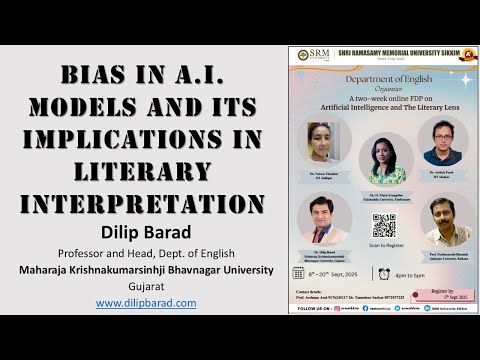
AI Bias and Literary Theory: How Algorithms Replicate Old Stereotypes

AI Bias and Literary Theory: How Algorithms Replicate Old Stereotypes I am writing this blog as an academic task assigned by Prof. Dr. Dilip...