Showing posts with label Dadaism. Show all posts

Tuesday, February 10, 2026

Major Literary Trends and Movements of the Twentieth Century


 Major Literary Trends and Movements of the Twentieth Century


This blog is written as part of the flipped learning activity for Unit 2: Trends and Movements in the MA English syllabus. It aims to provide a concise and structured understanding of major twentieth-century literary movements and concepts, helping in academic discussion, presentation, and examination preparation.

Introduction

The twentieth century witnessed significant shifts in literary thought and artistic expression, largely shaped by rapid social change, industrialization, and the impact of the World Wars. In response to the breakdown of traditional values and forms, writers and artists began to experiment with new techniques, themes, and structures, giving rise to various literary movements such as Modernism, Postmodernism, Expressionism, Surrealism, Absurdism, and the Avant-Garde. These movements reflect changing perceptions of reality, identity, language, and meaning, and they challenge conventional modes of representation. This blog offers an overview of these major trends and movements, with the aim of developing a clear conceptual understanding of their key features, historical contexts, and literary significance.

What is Modernism ? 


Definition of Modernism

Modernism is a major literary and cultural movement that developed in the late nineteenth and early twentieth century, particularly in the aftermath of World War I. It arose as a reaction against traditional literary forms, established moral values, and realistic modes of representation. Modernist writers believed that the rapidly changing modern world required new ways of expression, and therefore they experimented with form, language, and narrative techniques to represent modern experience more truthfully.

Historical Background

Modernism emerged during a period marked by industrialization, urbanization, scientific advancement, and war. These changes created a sense of uncertainty and disillusionment, leading writers to question religion, social order, and the idea of absolute truth. Literature became a space to explore this crisis of meaning.

Characteristics of Modernism

1. Rejection of Tradition

Modernist writers rejected classical forms, linear plots, and conventional narration. They deliberately broke away from earlier literary traditions to create innovative structures.

2. Focus on Inner Consciousness

Instead of external reality, Modernism emphasizes the inner thoughts, memories, and emotions of characters. Psychological depth becomes more important than physical action.

3. Fragmentation

Modernist texts often appear discontinuous or non-linear, reflecting the fragmented nature of modern life. This fragmentation can be seen in narrative structure, imagery, and language.

4. Sense of Alienation and Disillusionment

Themes of loneliness, loss, anxiety, and meaninglessness are common. Many Modernist works express the spiritual emptiness felt after the destruction caused by World War I.

5. Experimentation with Language and Form

Modernist writers experimented with symbolism, irony, ambiguity, and complex imagery. Meaning is often indirect and requires active interpretation by the reader.

Prominent Figures of Modernism

Some of the most important figures associated with Modernism include T. S. Eliot, Virginia Woolf, James Joyce, and Ezra Pound. Through their innovative works and techniques, these writers played a central role in shaping Modernism as a transformative literary movement.


Stream of Consciousness


Definition of Stream of Consciousness

Stream of Consciousness is a narrative technique used in modern literature to represent the continuous flow of thoughts, feelings, memories, and sensations in a character’s mind. Instead of presenting events in a logical or chronological order, this technique attempts to capture the way the human mind actually works—moving freely from one idea to another. It focuses on inner experience rather than external action and is closely associated with Modernism.

Origin and Background

The technique of stream of consciousness developed under the influence of modern psychology, particularly the ideas of Sigmund Freud and William James, who emphasized the complexity of human consciousness. Modernist writers adopted this technique to explore the inner life of characters in greater depth and realism.

Key Features of Stream of Consciousness

1. Non-linear Structure

Thoughts and memories appear in a fragmented and non-chronological manner, reflecting the natural movement of the mind.

2. Interior Monologue

The narration often takes the form of an interior monologue, where the reader has direct access to a character’s thoughts.

3. Free Association of Ideas

Ideas shift freely from present to past, from memory to sensation, without clear transitions.

4. Minimal Punctuation and Grammar

Traditional sentence structures are often ignored to convey the spontaneous flow of thoughts.

5. Psychological Depth

Greater emphasis is placed on emotions, perceptions, and mental states rather than external events.

Prominent Writers and Works

The technique is most famously used by Virginia Woolf, especially in Mrs Dalloway; James Joyce, notably in Ulysses; and William Faulkner in The Sound and the Fury. Through this technique, these writers transformed narrative style and deepened the psychological realism of modern fiction.


Expressionism


Definition of Expressionism

Expressionism is a modern literary and artistic movement that developed in the early twentieth century, mainly in Germany. It focuses on expressing inner emotions, psychological states, and subjective experiences rather than presenting an objective or realistic picture of the external world. Expressionist writers believed that reality should be shown as it is felt, not as it appears.

Historical Background

Expressionism emerged during a time of social unrest, industrialization, and the trauma of World War I. These conditions created anxiety, fear, and a sense of alienation, which are strongly reflected in Expressionist literature and drama.

Characteristics of Expressionism

1. Subjective Reality

Expressionism presents reality through the inner feelings and emotions of characters rather than through realistic description.

2. Distortion and Exaggeration

Characters, settings, and events are often distorted or exaggerated to convey psychological tension, fear, or anger.

3. Rejection of Realism

Expressionist writers deliberately rejected realism and naturalism, using symbolic and abstract techniques instead.

4. Themes of Anxiety and Alienation

Common themes include fear, isolation, spiritual crisis, and rebellion against modern society.

5. Symbolism and Abstraction

Language and imagery are highly symbolic, aiming to evoke emotional response rather than logical understanding.

Prominent Figures of Expressionism

Important figures associated with Expressionism include Georg Kaiser, Ernst Toller, and August Strindberg, whose dramatic works influenced the development of Expressionist theatre.


Absurdism


Definition of Absurdism


Absurdism is a literary and philosophical movement that presents human existence as irrational, meaningless, and illogical. It is based on the idea that people continuously search for meaning in a universe that offers none. Absurdist literature highlights the conflict between the human desire for order and the chaotic, purposeless nature of life. This movement became prominent in the mid-twentieth century, especially after the Second World War.

Philosophical Background

Absurdism is closely linked with existential philosophy, particularly the ideas of Albert Camus, who described the “absurd” as the tension between human longing for meaning and the silent universe. The devastation of war, loss of faith, and social uncertainty deeply influenced Absurdist writers.

Characteristics of Absurdism

1. Meaninglessness of Life

Absurdist works suggest that life has no clear purpose or logical explanation, and human efforts to find meaning often end in failure.

2. Illogical Plot and Structure

Plots are circular or repetitive, with little development or resolution, emphasizing stagnation and futility.

3. Breakdown of Language

Dialogue often appears nonsensical, repetitive, or fragmented, showing the inadequacy of language as a means of communication.

4. Sense of Isolation and Alienation

Characters are often lonely, disconnected, and unable to form meaningful relationships.

5. Dark Comedy

Humour is frequently used to highlight the tragic and ironic nature of human existence.

Prominent Figures of Absurdism

Major writers associated with Absurdism include Samuel Beckett, best known for Waiting for Godot; Eugène Ionesco; and Jean Genet, whose works exemplify the themes and techniques of the Absurd.


Surrealism


Definition of Surrealism

Surrealism is a literary and artistic movement that developed in the early twentieth century, aiming to explore the unconscious mind, dreams, and imagination. It rejects logical reasoning and realistic representation, seeking instead to reveal a deeper truth hidden beneath conscious thought. Surrealist writers and artists believed that reality is incomplete without the inclusion of dreams, fantasies, and irrational experiences.

Historical and Intellectual Background

Surrealism emerged after World War I and was strongly influenced by psychoanalytic theories, especially those of Sigmund Freud. Freud’s ideas about dreams, repression, and the unconscious encouraged writers to move beyond rational control and allow free expression of hidden desires and thoughts. Surrealism also developed as a reaction against social conventions and traditional artistic rules.

Characteristics of Surrealism

1. Emphasis on the Unconscious Mind

Surrealist works focus on dreams, fantasies, and subconscious thoughts rather than logical or conscious reasoning.

2. Dream-like and Illogical Imagery

Images and events often appear strange, bizarre, or unrealistic, resembling the structure of dreams.

3. Rejection of Rational Logic

Surrealism deliberately breaks logical connections, allowing irrational and unexpected associations.

4. Use of Symbolism

Symbols are used to represent hidden emotions, desires, and psychological conflicts.

5. Experimentation with Language and Form

Surrealist writers experiment with free writing, unexpected metaphors, and unconventional structures to achieve spontaneity.

Prominent Figures of Surrealism

Important figures associated with Surrealism include André Breton, who wrote the Surrealist Manifesto; Salvador Dalí, known for his dream-like paintings; and Paul Éluard, whose poetry reflects surrealist imagination and symbolism.


 Postmodernism


Definition of Postmodernism

Postmodernism is a literary and cultural movement that emerged in the mid-to-late twentieth century, mainly after the Second World War. It developed as a reaction against the seriousness, certainty, and structured worldview of Modernism. Postmodernism questions the ideas of absolute truth, fixed meaning, and grand narratives, suggesting instead that reality is multiple, unstable, and constructed through language and culture.

Historical and Intellectual Background

Postmodernism arose in a world shaped by globalization, mass media, consumer culture, and rapid technological change. Thinkers like Jean-François Lyotard argued that modern society no longer believes in universal explanations or ideologies. As a result, literature began to reflect fragmentation, skepticism, and playfulness rather than certainty.

Characteristics of Postmodernism

1. Rejection of Grand Narratives

Postmodernism challenges large, universal explanations of history, truth, and identity, emphasizing plurality and diversity instead.

2. Fragmentation

Texts often have non-linear structures, broken narratives, and multiple perspectives, with no clear beginning or end.

3. Metafiction

Postmodern works are often self-reflexive, openly acknowledging that they are works of fiction and questioning the act of storytelling itself.

4. Intertextuality and Pastiche

Postmodern writers borrow, mix, and parody earlier texts, styles, and genres, blurring the line between high and popular culture.

5. Irony and Playfulness

Serious themes are treated with humour, irony, and parody, rejecting fixed meanings and moral certainty.

Prominent Figures of Postmodernism

Important figures associated with Postmodernism include Jean-François Lyotard, Jacques Derrida, and literary writers such as Thomas Pynchon and Salman Rushdie. Their works reflect the experimental, playful, and questioning nature of Postmodern thought.


Avant-Garde Movement


Definition of the Avant-Garde Movement


The Avant-Garde Movement refers to experimental and innovative artistic and literary practices that challenge traditional forms, styles, and ideas. The term avant-garde comes from a French word meaning “advance guard,” suggesting artists and writers who move ahead of their time. In literature, the avant-garde aims to break conventions and create new ways of expression that reflect the rapidly changing modern world.

Historical Background

The Avant-Garde movement developed in the late nineteenth and early twentieth century, especially in Europe, during a period of industrial growth, urbanization, and social upheaval. The movement was strongly influenced by political unrest and the impact of World War I, which led artists to reject existing cultural values and artistic norms.

Characteristics of the Avant-Garde Movement

1. Rejection of Tradition

Avant-garde artists reject conventional literary forms, themes, and techniques, seeking new and radical modes of expression.

2. Experimentation

Strong emphasis is placed on innovation and experimentation with language, structure, and form.

3. Shock and Provocation

Many avant-garde works aim to shock or provoke the audience in order to question accepted beliefs and values.

4. Emphasis on Freedom and Originality

Creative freedom and originality are central, with artists refusing to follow established rules.

5. Social and Political Engagement

Avant-garde works often reflect political rebellion and critique of bourgeois society.

Major Avant-Garde Movements

The Avant-Garde includes several influential movements such as Futurism, Dadaism, Surrealism, and Expressionism, all of which contributed to reshaping modern art and literature.

Prominent Figures of the Avant-Garde

Important figures associated with the Avant-Garde include Filippo Tommaso Marinetti, founder of Futurism; Tristan Tzara; and André Breton, who played a key role in Surrealism.


Dada Movement


Definition of the Dada Movement

The Dada Movement, also known as Dadaism, was an avant-garde artistic and literary movement that emerged during World War I (around 1916). It arose as a strong reaction against war, nationalism, and the traditional values of art and culture. Dada rejected logic, reason, and aesthetic beauty, promoting nonsense, chaos, and absurdity as a form of protest against a world that had descended into violence and irrationality.

Historical Background

Dada originated in Zurich, Switzerland, at the Cabaret Voltaire, where artists and writers from different countries gathered to oppose war and bourgeois values. The movement later spread to cities such as Berlin, Paris, and New York. Dadaists believed that a society capable of producing war did not deserve traditional art.

Characteristics of the Dada Movement

1. Rejection of Traditional Art

Dadaists opposed conventional ideas of art, beauty, and meaning, often producing works that appeared meaningless or random.

2. Absurdity and Nonsense

Nonsense, irrationality, and playful absurdity were central to Dadaist expression.

3. Use of Chance and Randomness

Dada artists often used chance techniques, such as random word selection or collage, to create their works.

4. Collage and Readymade Art

Everyday objects were used as art forms, challenging the idea of artistic originality and skill.

5. Anti-War and Anti-Bourgeois Attitude

Dadaism strongly criticized war, nationalism, and middle-class values.

Prominent Figures of Dadaism

Key figures associated with the Dada Movement include Tristan Tzara, Hugo Ball, Marcel Duchamp, and Hans Arp. Their works challenged traditional artistic boundaries and redefined the concept of art itself.


Comedy of Menace


Definition of Comedy of Menace

Comedy of Menace is a dramatic style in which humour exists side by side with fear, threat, and anxiety. Ordinary situations and everyday conversations gradually become unsettling, creating an atmosphere of tension and danger beneath the surface. The audience may laugh, but the laughter is often uneasy, as it is mixed with a sense of impending menace.

Origin of the Term

The term “Comedy of Menace” was first used by critics to describe the plays of Harold Pinter. Pinter’s drama combines realistic dialogue with hidden violence, power struggles, and psychological threat, making the familiar world appear strange and disturbing.

Characteristics of Comedy of Menace

1. Ordinary Settings with Hidden Threat

The plays are usually set in familiar places such as rooms or houses, but these spaces gradually become claustrophobic and threatening.

2. Ambiguous Characters

Characters are often mysterious, and their intentions are unclear. This ambiguity creates fear and uncertainty.

3. Menacing Silence and Pauses

Silence, pauses, and unfinished dialogue play a crucial role, suggesting unspoken violence or dominance.

4. Power Struggle

Relationships in Comedy of Menace are marked by control, domination, and intimidation, rather than harmony.

5. Dark and Uneasy Humour

Comedy arises from awkward situations and trivial conversations, but it is always overshadowed by menace.

Major Example

A well-known example of Comedy of Menace is The Birthday Party, in which a seemingly harmless birthday celebration turns into a psychologically disturbing experience filled with threat and fear.

Significance

Comedy of Menace reflects the insecurities and anxieties of modern life, showing how violence and fear can exist beneath normal social behaviour. It also challenges the audience to question the stability of everyday reality.


Theatre of the Absurd


Definition of Theatre of the Absurd

Theatre of the Absurd is a form of modern drama that presents human life as meaningless, irrational, and purposeless. It reflects the belief that human beings live in a world where logical explanations and traditional values have collapsed. Instead of clear plots and realistic dialogue, Absurd drama uses illogical situations, repetition, silence, and absurd humour to express the futility of human existence.

Philosophical Background

The Theatre of the Absurd is closely connected with existential philosophy, particularly the ideas of Albert Camus, who described the “absurd” as the conflict between humanity’s search for meaning and an indifferent universe. The devastation and disillusionment following the Second World War played a major role in shaping this dramatic form.

Characteristics of Theatre of the Absurd

1. Illogical Plot Structure

Absurd plays often have no clear beginning, middle, or end. Events are repetitive or circular, emphasizing stagnation rather than progress.

2. Breakdown of Language

Dialogue is frequently nonsensical, repetitive, or meaningless, highlighting the failure of language as a tool of communication.

3. Sense of Isolation

Characters are portrayed as lonely and disconnected, unable to form meaningful relationships.

4. Use of Silence and Pauses

Silence, pauses, and inaction are significant dramatic techniques, suggesting emptiness and uncertainty.

5. Dark Comedy

Tragic situations are presented with humour, creating a blend of comedy and despair.

Major Playwrights of the Theatre of the Absurd

Important playwrights associated with the Theatre of the Absurd include Samuel Beckett, best known for Waiting for Godot; Eugène Ionesco; Jean Genet; and Harold Pinter, whose plays also show absurd elements.

Significance

The Theatre of the Absurd challenges traditional drama by rejecting logical structure and clear meaning. It forces the audience to confront the absurd condition of human life and to question the reliability of language, reason, and social norms.


Conclusion

The literary trends and movements discussed in this unit reflect the profound changes in human thought, society, and artistic expression during the twentieth century. Movements such as Modernism, Expressionism, Surrealism, Absurdism, Postmodernism, Dadaism, and concepts like Stream of Consciousness, Comedy of Menace, and the Theatre of the Absurd emerged as responses to war, industrialization, psychological inquiry, and the breakdown of traditional values. Together, these movements challenged conventional forms, questioned meaning and reality, and introduced innovative techniques that reshaped literature and drama. Understanding these trends is essential for appreciating modern and contemporary literary works, as they reveal how literature continually evolves to represent the complexities and uncertainties of human experience.
Saturday, January 31, 2026

Finding Meaning Where None Is Given: A Reflection on Existentialism

 Finding Meaning Where None Is Given: A Reflection on Existentialism

I am writing this blog as part of the Flipped Learning Activity on Existentialism: Ask Questions, assigned by Prof. Dr. Dilip P. Barad. This activity encouraged me to engage with existentialist philosophy through self-directed learning by exploring video resources and related readings before reflecting critically in writing. Instead of passively receiving interpretations, the flipped learning approach prompted me to question, analyze, and connect key existentialist ideas such as absurdity, freedom, anxiety, and responsibility with human experience. Writing this blog allows me to articulate my understanding of existentialism as a lived philosophy rather than a purely theoretical system, while also responding thoughtfully to the questions that emerge from engaging with thinkers like Camus, Sartre, Kierkegaard, and Nietzsche.

Introduction

Existentialism emerges as a philosophical response to the problem of human meaning in a world no longer anchored by religious, metaphysical, or moral certainties. Rather than offering comforting answers, it confronts individuals with the unsettling realities of freedom, anxiety, and responsibility. Thinkers such as Søren Kierkegaard, Friedrich Nietzsche, Jean-Paul Sartre, Martin Heidegger, and Albert Camus explore the human condition by emphasizing subjectivity, choice, finitude, and the tension between the desire for meaning and the indifference of the universe. Central to existentialist thought is the claim that “existence precedes essence,” which rejects any predetermined human nature and insists that individuals must create meaning through their actions. By engaging with concepts such as absurdity, angst, and revolt, existentialism challenges individuals to live authentically in an uncertain world, making it not only a philosophical movement but a profound inquiry into how one ought to live.

Video 1: What Is Existentialism?

Faith, Absurdity, and Philosophical Suicide

The video’s exploration of God and faith within existentialist thought strongly shaped my understanding of the philosophy. From Albert Camus’s viewpoint, seeking refuge in God as a final explanation for life’s suffering risks becoming philosophical suicide, a refusal to face the absurd condition of existence. Existentialist thinkers consistently emphasize that human life unfolds in a world without guaranteed meaning. In such a context, faith may operate as emotional reassurance rather than as an active confrontation with uncertainty, enabling individuals to distance themselves from the difficult task of accepting responsibility for their own lives.

Freedom, Responsibility, and Authentic Existence

The video further clarifies why existentialism approaches such reliance with skepticism. Belief in a predetermined divine order can reduce personal freedom by transferring responsibility to an external authority. When meaning is presumed to be fixed in advance, the individual is spared the anxiety of choice. Existentialism rejects this comfort and instead positions human beings directly before freedom, responsibility, and existence itself. Although this confrontation generates anxiety, it also makes authentic living possible. To live authentically is to recognize that one’s actions cannot be justified by fate or divine will. As Jean-Paul Sartre argues, human beings are “condemned to be free,” and it is this inescapable responsibility that ultimately gives human life its seriousness and value.

Video 2: The Myth of Sisyphus (The Absurd Reasoning)

Absurdity, Suicide, and the Question of Meaning

The problem of meaning has remained central to human thought, and Albert Camus directly addresses this concern in his philosophical essay The Myth of Sisyphus. The essay opens with a striking claim: the most serious philosophical problem is suicide, a response that arises when life appears fundamentally absurd. Camus examines how the human desire for clarity and purpose clashes with the world’s indifference, creating a condition in which individuals are tempted either to abandon life or to seek refuge in false hope. Rather than choosing despair or escape, Camus proposes an alternative response to the absurd—one that neither denies suffering nor evades reality.

Imagining Sisyphus Happy: Revolt Through Conscious Struggle

Camus’s concluding image, “One must imagine Sisyphus happy,” radically reshapes the idea of triumph. Condemned to push a stone endlessly uphill only to see it fall back again, Sisyphus represents the repetitive and often unrewarding routines of modern human life. People continue to work, struggle, and persist without any assurance of ultimate fulfillment. Yet Camus does not suggest ignoring the weight of the stone; instead, he insists on recognizing it fully. Sisyphus’s happiness lies in his awareness and acceptance of his fate. His continued effort becomes an act of rebellion against meaninglessness, demonstrating that value does not arise from final outcomes but from the conscious engagement with struggle itself. In this way, the act of pushing the stone becomes an assertion of human dignity and freedom within an indifferent universe.

Video 3: The Myth of Sisyphus (Philosophical Suicide)

Philosophical Suicide and the Refusal of Escape

Albert Camus argues that when individuals are unable to remain within the condition of the absurd, they often respond in one of two ways: either by sinking into despair or by committing what he terms philosophical suicide. This form of suicide does not involve physical death but the abandonment of reason through belief in transcendent meaning. Unlike Søren Kierkegaard, who resolves the absurd through faith, Camus maintains that the absurd admits no final solution. It can only be acknowledged and sustained. From this perspective, the concluding stance of The Myth of Sisyphus becomes clearer—not as a resolution to the absurd, but as a conscious refusal to escape from it.

Negation as Honesty Rather Than Despair

The notion of “negation” is central to Camus’s thought and must not be confused with hopelessness. Philosophical suicide occurs at the moment of the “leap,” when reason relinquishes itself to faith or illusion in search of comfort. By rejecting this leap, the existential individual chooses to remain within the tension of the absurd. Though uncomfortable, this position represents a radical form of intellectual honesty. It involves facing the world’s indifference without self-deception and resisting the temptation to fabricate meaning where none is given. By sustaining this negation, one accepts both the human longing for meaning and the silence of the universe, choosing to live consciously within that unresolved tension rather than dissolving it through false consolation.

Video 4: Dadaism, Nihilism, and Existentialism


Dadaism as a Reaction to War and Collapse of Meaning

The Dada movement emerged in the aftermath of the First World War as a radical response to the cultural, political, and intellectual systems that had led to unprecedented violence and destruction. Rather than promoting harmony or aesthetic beauty, Dada deliberately embraced chaos, absurdity, and irrationality to expose the emptiness of the so-called “civilized” values that justified war. Through its disruptive artistic practices, Dada questioned the credibility of nationalism, authority, and rational progress, revealing how these ideals had failed humanity. In this sense, Dadaism redirected attention from collective national glory to the fragmented experience of the individual. This shift is clearly visible in modern literature, particularly war poetry, which moves away from patriotic celebration toward an exploration of personal trauma, alienation, and disillusionment.

From Destruction to Reconstruction: Dadaism and Existentialism

The relationship between Dadaism and Existentialism can be understood as sequential and complementary. Dadaism operates as a force of destruction, dismantling inherited values and exposing their hollowness, while Existentialism assumes the task of reconstruction. By rejecting established systems of meaning, Dadaism creates a philosophical and cultural vacuum—a blank slate upon which new ways of thinking become possible. Existentialism enters this space not to restore old certainties but to ask a more urgent question: how should one live once traditional meanings have collapsed? Where Dadaism denies coherence and mocks authority, Existentialism turns inward, focusing on individual consciousness, freedom, and responsibility. In this way, Dadaism clears the ground of false meanings, allowing Existentialism to center human existence itself as the starting point for creating meaning in a fractured world.

Video 5: Existentialism – A Gloomy Philosophy?

Facing Discomfort Rather Than Escaping It

Existentialism often earns its reputation as a dark or pessimistic philosophy because it forces individuals to confront unsettling questions about life, meaning, and mortality. By foregrounding emotions such as anxiety, despair, confusion, and absurdity, it unsettles long-held belief systems that once provided comfort and certainty. This confrontation can feel threatening, leading many to associate existentialism with nihilism or self-absorption. The unease arises not because the philosophy invents despair, but because it refuses to soften or conceal the difficult realities of human existence. In this sense, existentialism can indeed appear gloomy, as it dismantles familiar frameworks and compels individuals to rethink how they understand themselves and the world.

Gloom as Awareness, Not Defeat

Yet, despite its somber tone, existentialism should not be mistaken for a philosophy of resignation. Its apparent bleakness can be understood as a form of intellectual courage rather than pessimism. By exposing the absence of inherent purpose and the inevitability of death, existentialism encourages a heightened awareness of life rather than indifference toward it. Avoiding these realities leads to what Sartre describes as bad faith, a condition in which individuals deceive themselves to escape responsibility. In contrast, confronting anxiety and finitude allows one to live more honestly and deliberately. Although existentialism strips away comforting illusions, it does so to restore human dignity—urging individuals to live consciously, choose responsibly, and engage fully with the reality of their existence.

Video 6: Existentialism and Nihilism


Between Meaninglessness and Revolt

At first, Camus’s treatment of Sisyphus appears to present two opposing responses to an absurd existence: resignation through imagined happiness or rebellion against a meaningless fate. From this surface view, life seems trapped between false comfort and impossible resistance, making the absurd appear overwhelming and inescapable. Such a reading risks aligning existentialism with nihilism, where meaning collapses entirely and human effort appears futile.

Happiness as Resistance, Not Escape

A closer engagement with Camus, however, reveals that imagining Sisyphus happy is not an act of philosophical suicide but its complete rejection. Philosophical suicide would occur if Sisyphus abandoned his task by seeking hope in transcendence, divine justice, or a promised future life. That would be an escape from the absurd. Instead, Sisyphus continues pushing the stone with full awareness of its futility, transforming his labor into an act of rebellion. His acceptance of fate does not signal surrender but defiance. By choosing to affirm his struggle, he deprives the absurd of its power to dominate him. The meaninglessness of the task remains, but it no longer determines his inner life. In this way, Camus shows that true revolt lies not in opposing God or destiny, but in refusing to let an indifferent universe dictate one’s capacity for dignity and affirmation.

Video 7: Let Us Introduce Existentialism Again!


Existentialism and the Question of the Human Condition

This video provides a clear and accessible reintroduction to existentialism, a philosophy often described as difficult precisely because it resists fixed definitions. Rather than presenting existentialism as a closed system, the video frames it as an ongoing inquiry into the human condition. It focuses on fundamental questions such as why human beings exist and how they ought to live in a world without absolute or predetermined answers. Central to this perspective is the existentialist insistence that meaning cannot be inherited from religion or tradition but must be actively confronted and constructed by the individual.

From the Absence of Meaning to the Creation of Meaning

A key concept explored in the video is Jean-Paul Sartre’s assertion that “existence precedes essence,” which challenges classical philosophical and religious views that assume a fixed human nature. Instead, human beings define themselves through their choices and actions. The video also carefully distinguishes existentialism from nihilism. While both reject the idea of objective, universal meaning, nihilism concludes that nothing matters, whereas existentialism treats this absence as a condition of freedom. Drawing on Nietzsche’s call to “become who you are,” existentialism transforms the loss of external meaning into an opportunity for self-creation. Meaning is not discovered ready-made but forged through engagement, responsibility, and conscious decision-making. In this sense, existentialism invites individuals to confront uncertainty directly and take ownership of their lives rather than surrendering to indifference or conformity.

Video 8: Explain Like I’m Five (Nietzsche)


Simplifying Philosophy for Accessibility

This video attempts to introduce Nietzschean ideas through a child-friendly framework, using familiar situations such as questioning parental authority and socially defined notions of “good” behavior. By translating abstract concepts into everyday experiences, the video succeeds in making difficult philosophical ideas more approachable. This method demonstrates how philosophy can be introduced at an early cognitive level by anchoring it in relatable human experiences rather than abstract theory.

The Risk of Oversimplification

Despite its accessibility, the video also reveals the limitations of extreme simplification. Presenting Nietzsche’s concept of the Übermensch as someone who simply does whatever they desire risks distorting the philosopher’s core argument. Nietzsche’s philosophy emphasizes self-overcoming, discipline, and the creative responsibility of forming one’s own values, rather than unrestrained freedom or moral chaos. From an academic standpoint, the video highlights the challenge of communicating complex philosophical ideas without sacrificing conceptual accuracy. While simplification can invite engagement, it must be handled carefully to avoid reducing nuanced thought to misleading generalizations. For me, this video underscores the importance of balancing clarity with intellectual responsibility when introducing philosophy to broader audiences.

Video 9: Why I Like Existentialism (Eric Dodson)


Existentialism as a Lived Philosophy

Eric Dodson’s personal reflection on existentialism strongly resonates with my understanding of the philosophy as something lived rather than merely studied. He presents existentialism not as an abstract intellectual exercise, but as a practical orientation toward life. His distinction between the philosophy’s intellectual appeal and its deeper emotional and existential impact effectively captures the spirit of the idea that existence precedes essence. Identity, in this sense, is not shaped by theoretical definitions but by lived experience, emotional engagement, and conscious participation in life.

Suffering, Honesty, and Personal Growth

What stands out most in Dodson’s account is his emphasis on existentialism’s uncompromising honesty about suffering and absurdity. The suggestion that suffering is not an enemy but a potential source of insight reframes discomfort as a necessary condition for growth. This perspective encourages resilience by teaching individuals to confront hardship instead of avoiding it. Dodson’s appreciation for existentialism’s rebellious spirit further highlights its transformative potential. By urging individuals to recognize the extent of their freedom and responsibility, existentialism invites active engagement with life rather than passive observation. This approach empowers individuals to create meaning through choice and commitment, ultimately leading to a more intense and conscious experience of life’s possibilities.

Video 10: Let Us Sum Up (Essentialism vs. Existentialism)


Understanding Essentialism through Contrast

This video offers a clear and effective summary of existentialism by first introducing the concept of essentialism. Essentialism is explained as the belief that all entities possess a fixed essence or purpose prior to their existence. The use of a simple analogy—such as a knife requiring a blade to fulfill its function—successfully illustrates how an object’s identity is defined by predetermined characteristics. This explanation makes it easier to understand how traditional philosophical and religious frameworks often extend this logic to human beings, assuming that individuals are born with an inherent nature or destiny.

From Predetermined Purpose to Self-Creation

By establishing essentialism as a point of departure, the video clarifies the radical break introduced by existentialism. The existentialist claim that “existence precedes essence” rejects the idea of a preassigned human purpose and instead places responsibility on individuals to define themselves through action and choice. This contrast highlights the shift from a worldview grounded in divine or metaphysical certainty to one centered on freedom and self-creation. The video’s comparative approach allows the core difference between essentialism and existentialism to emerge naturally, making complex philosophical ideas more accessible and reinforcing the existentialist emphasis on human responsibility and autonomy.

The Video I Liked Personally

Among all the videos explored in this flipped learning activity, Video 3: The Myth of Sisyphus (Philosophical Suicide) left the strongest impression on me, particularly when read alongside Video 6: Existentialism and Nihilism. What draws me to these videos is not their promise of comfort but their refusal to offer one. The ideas of philosophical suicide, the inevitability of the absurd, and the temptation of the “leap” force us to confront an uncomfortable truth: that meaning is not guaranteed, and hope itself can sometimes function as an escape rather than a solution. While existentialism often feels relevant to modern life, these videos make it clear why it is so rarely practiced. Social structures encourage certainty, conformity, and emotional reassurance, whereas existentialism demands honesty, discomfort, and personal responsibility. When faced with this conflict, individuals often choose what is socially acceptable or emotionally easier rather than what aligns with their inner truth.

The distinction between existentialism and nihilism, clarified in the video on nihilism, further deepens this understanding. Nihilism acknowledges the absence of objective meaning but collapses into indifference, concluding that nothing truly matters. Existentialism begins at the same point yet moves in the opposite direction. The absurd individual recognizes that “seeking what is true is not the same as seeking what is desirable,” and still chooses to live consciously. Philosophical suicide—the leap toward faith, hope, or transcendence—becomes the easier option because it dissolves tension. The truly difficult path is to remain in the fragile moment before the leap, aware of absurdity without denying it. Even if life offers no ultimate meaning, these videos suggest that one can still live authentically by embracing absurdity without surrendering one’s personal vision. It is within this tension between nihilistic emptiness and existential revolt that human experience gains depth, intensity, and dignity.

Learning Outcomes

Has my comprehension of Existentialist philosophy improved?

This flipped learning activity has significantly enhanced my understanding of existentialist philosophy. Earlier, my familiarity with existentialism was largely limited to thinkers such as Nietzsche and Camus. Through this activity, I was introduced to a broader range of existentialist ideas and philosophers, along with key concepts such as philosophical suicide, the nature of the absurd, and Aristotle’s notion of essentialism. In addition, the activity expanded my intellectual scope by offering insights into related movements and ideas such as Dadaism, nihilism, and narcissism. These concepts helped me understand existentialism not in isolation, but as part of a wider philosophical and cultural response to modernity.

Do I feel more confident discussing or writing about Existentialism?

Yes, this activity has increased my confidence in both discussing and writing about existentialist philosophy. By engaging with video resources, reflections, and comparative ideas, I gained a clearer grasp of existentialism’s historical background, its central arguments, and its connections with other philosophical and artistic movements. This structured engagement has enabled me to articulate existentialist ideas with greater clarity and coherence, making me more comfortable responding to questions or developing critical arguments related to existentialism.

Has this exercise clarified previously unclear concepts?

This exercise has brought substantial clarity to concepts that were earlier confusing for me. I had previously struggled to clearly distinguish between philosophical movements such as Dadaism, nihilism, and existentialism, especially in terms of their aims and responses to modern life. Through this activity, these distinctions became much clearer. It also deepened my understanding of key existentialist thinkers such as Camus, Sartre, and Kierkegaard, helping me grasp their differing approaches to freedom, meaning, and faith. Overall, the activity not only clarified my earlier doubts but also introduced new perspectives that strengthened my conceptual foundation.

Questions for Further Reflection

  1. If existentialism rejects external moral frameworks, how can ethical responsibility be justified without appealing to religion or tradition?

  2. Does living authentically require withdrawing from social expectations, or can authenticity exist within conformity?

  3. Can existential freedom become a burden so heavy that it limits action rather than enabling it?

  4. In a world governed by chance and absurdity, what distinguishes existential courage from mere stubborn persistence?

  5. If meaning is created through action, how should existentialism respond to failure, regret, or irreversible choices?

Conclusion

This flipped learning activity on existentialism has offered a meaningful opportunity to engage with philosophy as a lived and questioning practice rather than a fixed system of thought. Through the exploration of various video resources, the core existentialist concerns of absurdity, freedom, responsibility, and authenticity became clearer and more interconnected. Thinkers such as Camus, Sartre, Nietzsche, and Kierkegaard reveal that the absence of predetermined meaning is not an endpoint of despair but a starting point for conscious living. Existentialism challenges individuals to confront uncertainty without retreating into comforting illusions, urging them instead to assume responsibility for their choices and values.

What emerges from this engagement is an understanding of existentialism not as a gloomy or nihilistic philosophy, but as one grounded in intellectual honesty and human dignity. By refusing easy answers and false consolations, existentialism affirms the seriousness of human existence and the courage required to live authentically. This activity has reinforced the idea that meaning is neither discovered nor inherited, but continuously created through action, awareness, and commitment. Ultimately, existentialism invites individuals to remain awake to the tensions of life, embracing both its absurdity and its potential for depth, freedom, and self-created purpose.

References

Barad, Dilip. “Existentialism: Video Resources.” Dilip Barad | Teacher Blog, 19 Sept. 2016,
blog.dilipbarad.com/2016/09/existentialism-video-resources.html. Accessed 23 Jan. 2026.

Dostoevsky, Fyodor. Crime and Punishment. Translated by Constance Garnett, Project Gutenberg,
28 Mar. 2006, www.gutenberg.org/files/2554/2554-h/2554-h.htm.

Dostoevsky, Fyodor. Notes from the Underground. Translated by Constance Garnett, Project Gutenberg,
1 July 1996, www.gutenberg.org/ebooks/600.

Dostoevsky, Fyodor. The Brothers Karamazov. Translated by Constance Garnett, Project Gutenberg,
12 Feb. 2009, www.gutenberg.org/files/28054/old/28054-pdf.pdf.

Gallagher, Shaun, et al. “Existentialism.” Stanford Encyclopedia of Philosophy,
6 Jan. 2023, plato.stanford.edu/entries/existentialism/. Accessed 23 Jan. 2026.

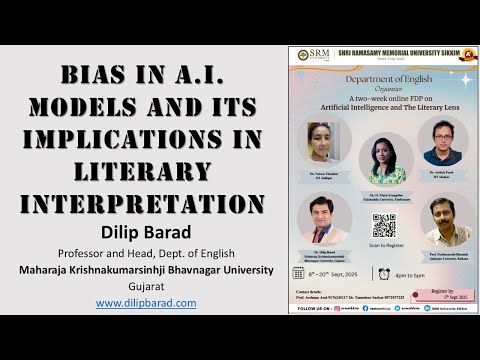
AI Bias and Literary Theory: How Algorithms Replicate Old Stereotypes

AI Bias and Literary Theory: How Algorithms Replicate Old Stereotypes I am writing this blog as an academic task assigned by Prof. Dr. Dilip...